 ReefDeck
Open the free logbook
ReefDeck
Open the free logbook
Salinity and Specific Gravity in a Reef Tank: Getting It Right
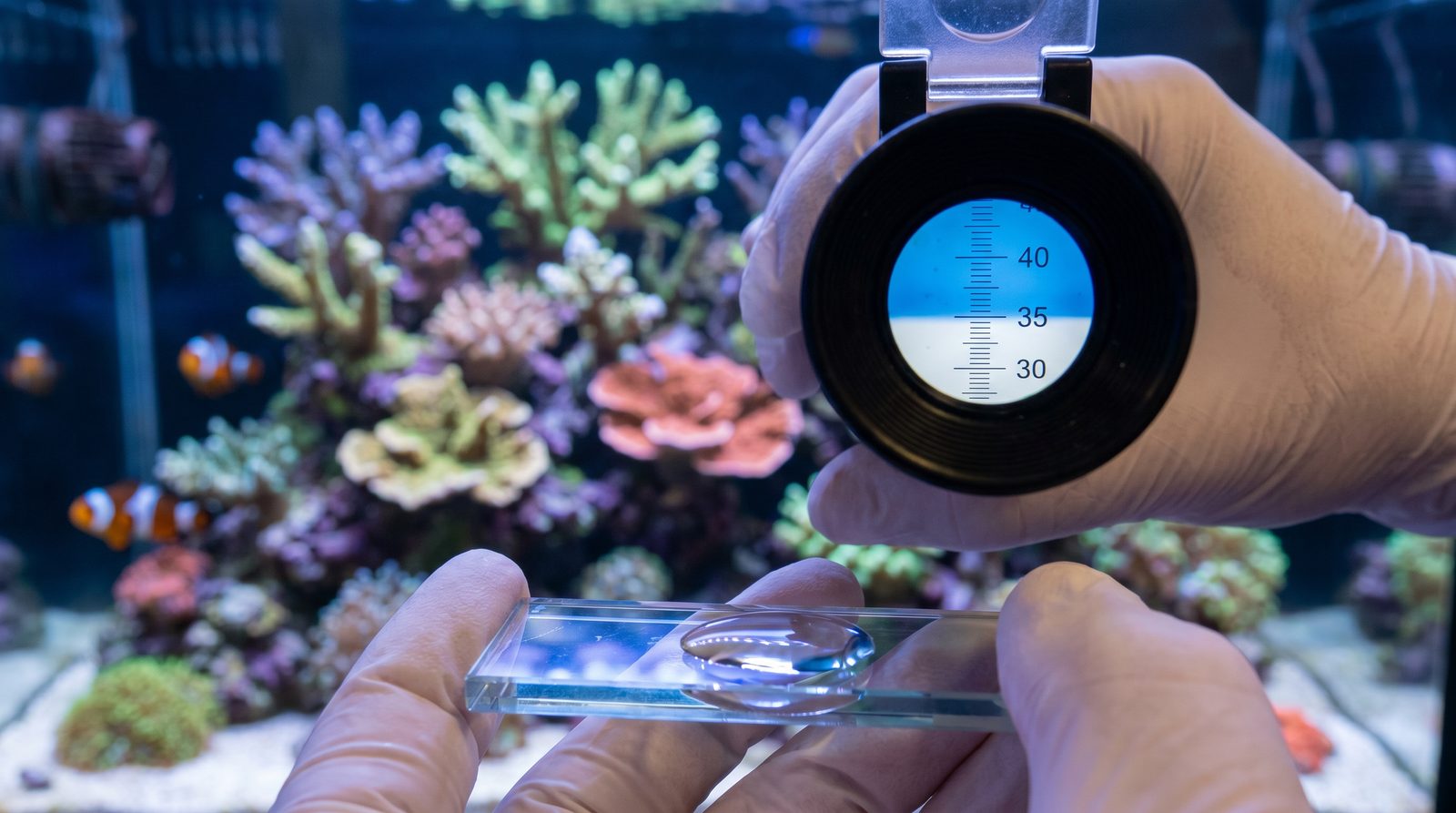
Target salinity is 35 ppt — about 1.025–1.026 specific gravity for a mixed reef — not the 1.023–1.024 of older fishkeeping wisdom. Salinity drifts upward every day because only freshwater evaporates; an auto top-off or daily manual top-off keeps it steady. Always calibrate your refractometer with calibration fluid, not tap water, and match new saltwater to your tank's salinity before adding it.
Salinity is one of the simplest parameters to understand — and one of the most common sources of slow, invisible stress in reef tanks. It rarely crashes overnight the way alkalinity can, but a tank that drifts half a point over a week, or that swings during every water change, is quietly working against every coral and invertebrate in it. Getting a clear picture of what salinity actually is, how to measure it properly and how evaporation pulls it out of range is worth more than any expensive piece of test kit.
Salinity and specific gravity: the difference
Seawater salinity is the amount of dissolved salt in the water, expressed in parts per thousand (ppt) or grams per litre. Natural seawater runs at approximately 35 ppt. Specific gravity (SG) is a different way to express the same thing: it compares the density of your water to the density of pure freshwater. At 25 °C, 35 ppt corresponds to a specific gravity of about 1.0264 — commonly rounded to 1.026. The two values describe the same property and hobbyist instruments often display either or both.
The distinction matters because specific gravity is temperature-dependent. The same dissolved salt produces a slightly different SG reading at 20 °C than at 25 °C. A well-made refractometer corrects for this; a swing-arm hydrometer sitting in your cold sump does not.
Why 1.025 — not 1.023
For many years, hobby advice pushed salinity in the range of 1.022–1.024, partly inherited from fish-only systems where lower salinity reduces the reproduction rate of some parasites. Reefs are different. Corals, clams, echinoderms and most invertebrates evolved in open-ocean water near 35 ppt, and running significantly below that creates chronic osmotic stress. The consensus among modern reef keepers and the research supporting it now puts the target squarely at 35 ppt — about 1.025–1.026 SG. 1.023 is noticeably low for mixed reef systems with SPS or sensitive invertebrates.
Measuring salinity: three methods compared
Every measurement method has trade-offs in accuracy, cost and convenience. Knowing where each one falls short helps you decide how much confidence to place in a given reading.
| Method | Accuracy | Notes |
|---|---|---|
| Swing-arm hydrometer | ±0.002 SG | Cheap and widely available. Bubbles on the arm cause false readings; accuracy drifts with age and deposits. Not suitable as a sole reference instrument. |
| Optical refractometer | ±0.001 SG | Reliable when calibrated. Must use calibration fluid (35 ppt standard) — not tap water or RO. ATC (automatic temperature compensation) required. |
| Digital probe / controller | ±0.0005 SG or better | Highest accuracy and continuous monitoring. Probes require regular calibration with a 35 ppt standard solution. Drift over months if neglected. |
Why salinity drifts: evaporation
This is the most important piece of salinity physics to internalise: only freshwater evaporates. Salt does not. Every litre that leaves your tank via evaporation from the sump, display, or equipment increases the concentration of salt in the water that remains. Left unchecked, a 200-litre reef tank can lose several litres per day, shifting salinity noticeably higher within days.
The solution is top-off with pure fresh water — RO or RO/DI — to replace what evaporated. An auto top-off (ATO) system does this automatically via a float switch or optical sensor, keeping salinity far steadier than daily manual additions. If you top off manually, do it every day at roughly the same time and track how much you add — a sudden increase in daily top-off volume is an early signal that something is evaporating faster than usual.
Mixing and matching new saltwater
Adding new saltwater that is a different salinity from your display is a fast route to a salinity swing. Always mix salt to the same target as your tank (around 1.025–1.026 SG), check it with a calibrated instrument, and allow the mix to circulate fully before measuring. Many hobbyists mix and store saltwater in a dedicated container with a pump running for at least 24 hours before use. This also ensures the salt is fully dissolved and the water is at a stable temperature.
The same logic applies to correcting a tank that has drifted high or low. Moving more than 0.001–0.002 SG per day is faster than most advice recommends. Slow, deliberate corrections over several days give your animals time to adjust.
What osmotic stress looks like
Salinity at the extremes — say, above 1.028 or below 1.020 — causes clear visible harm. At milder, longer-term deviations the signs are subtler: sluggish or recessed coral polyps, clams that fail to open fully, brittle stars staying hidden, fish that look marginally off and are harder to settle. Because these signs are non-specific, they are easy to attribute to other causes, which is exactly why a reliable salinity baseline and a log of readings over time makes a difference.
Logging each salinity measurement — date, reading and what you added or changed — turns a snapshot into a trend. A refractometer reading that looks fine today tells you nothing about whether salinity has been rising or falling all week. A log of the last ten readings does.
Log every salinity reading in ReefDeck
ReefDeck is a free, offline reef logbook. Record salinity alongside every other test, watch the trend over weeks, and catch drift before it stresses your corals — no account required, and your data stays on your device.
Open ReefDeck — it's free → Works on phone and desktop · installs as an app · exports to CSV anytimeFrequently asked questions
What is the ideal salinity for a reef tank?
The target for a mixed reef is 35 ppt, which is about 1.025–1.026 specific gravity (35 ppt ≈ 1.0264 SG at 25 °C). This matches natural seawater and is better for corals and invertebrates than the lower 1.022–1.024 levels historically recommended for fish-only systems.
Why does salinity rise in a reef tank?
Only freshwater evaporates from a reef tank — the dissolved salt stays behind. As water evaporates from the sump and display, the remaining water becomes progressively saltier. Topping off daily with pure RO or RO/DI water replaces what was lost and keeps salinity steady. An auto top-off system automates this.
How do I calibrate a refractometer for reef use?
Use a purpose-made 35 ppt calibration fluid, not tap water or RO water. Place one or two drops on the prism, close the cover and read the scale; adjust the calibration screw until the reading matches the fluid's 35 ppt (about 1.026 SG). Recalibrate monthly and whenever the refractometer has been exposed to extreme temperatures or impacts.
How quickly can I adjust salinity if it has drifted?
Aim for a maximum correction of about 0.001–0.002 SG per day. Moving salinity faster than that forces your corals and invertebrates to adjust their internal fluid balance rapidly, which stresses them. If salinity has drifted well outside range, a slow correction over several days is far safer than a large water change to fix it in one go.