 ReefDeck
Open the free logbook
ReefDeck
Open the free logbook
The Reef Tank Maintenance Schedule That Actually Works
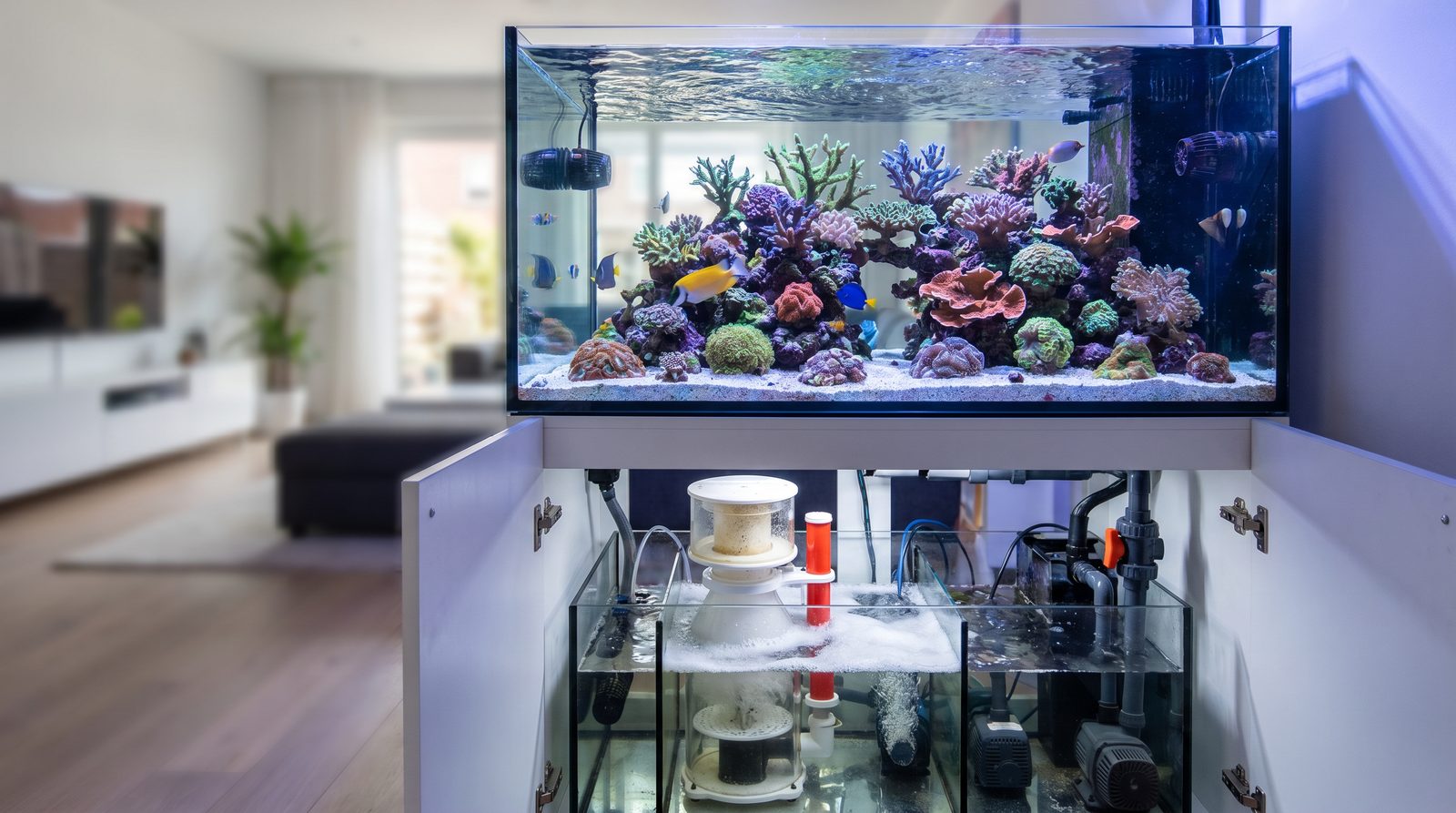
A reliable reef maintenance routine has three layers: daily glances at temperature, salinity, top-off level and livestock behaviour; weekly full parameter tests, a 10–15% water change, skimmer clean and glass scrape; and monthly equipment deep-cleaning, carbon or GFO replacement and a log review for slow trends. The real risk is not a single missed task — it is an inconsistent pattern that lets parameters drift for weeks before you notice.
Ask any experienced reef keeper what keeps a tank stable long-term and the answer is almost never a specific product or dosing strategy. It is a repeatable routine — the same tasks done on the same cadence, with results written down. Without a schedule, maintenance becomes reactive: you test when something looks off, you clean when the glass gets dark, you change water when you remember. That reactive pattern is how small drifts become expensive problems. A written, logged schedule does not just keep the tank cleaner; it keeps you honest about the gaps.
The full maintenance schedule at a glance
The table below covers the core tasks most mixed-reef keepers should be doing. Dedicated SPS systems may require more frequent alkalinity testing; softie-only tanks can tolerate a slightly looser cadence. Use it as a starting framework, not a rigid rulebook.
| Frequency | Task | Notes |
|---|---|---|
| Daily | Check display temperature | Verify heater and chiller are holding — consistency matters more than the exact target. |
| Daily | Check salinity (refractometer or probe) | Top-off evaporation with fresh RO/DI; do not top-off with saltwater. |
| Daily | Observe livestock behaviour | Unusual hiding, loss of appetite or closed polyps are early warning signs. |
| Daily | Confirm auto top-off (ATO) reservoir level | An empty ATO reservoir can let salinity creep up within hours on a small system. |
| Weekly | Test alkalinity, calcium, magnesium | Log all three together; they interact and should be interpreted as a set. |
| Weekly | Test nitrate and phosphate | Aim for 1–10 ppm NO₃ and 0.03–0.10 ppm PO₄; zero is not the goal. |
| Weekly | Water change 10–15% | Use freshly mixed saltwater at 1.025 and match temperature before adding. |
| Weekly | Clean protein skimmer neck and cup | A fouled skimmer neck can cut export efficiency dramatically. |
| Weekly | Scrape display glass | Coralline and diatom buildup reduces light penetration to lower colonies. |
| Weekly | Inspect equipment | Check powerhead impellers, heater indicator lights, return pump flow rate. |
| Monthly | ICP test or full macro-nutrient panel | Reveals elements that weekly testing does not cover — iodine, strontium, potassium, heavy metals. |
| Monthly | Deep-clean sump and refugium | Remove detritus from baffles and sump floor before it fuels a nutrient spike. |
| Monthly | Replace carbon and/or GFO media | Exhausted carbon stops removing yellowing compounds; exhausted GFO may leach phosphate. |
| Monthly | Calibrate probes (pH, salinity, temperature) | Drift in sensors means your log data is lying to you; calibration takes minutes. |
| Monthly | Review parameter logs for trends | Look for slow climbs or falls across the month — the kind a single test will not show. |
Daily tasks: the two-minute health check
Daily maintenance is not about doing much — it is about looking closely. Temperature and salinity take thirty seconds to glance at. What matters is doing it consistently enough that an anomaly registers immediately rather than three days later. A heater that failed overnight will show clearly on a morning temperature check; a faulty ATO that ran dry will show on a salinity probe before it climbs high enough to stress fish.
The most underrated daily task is simply watching the tank. Closed polyps on an LPS coral, a fish that has stopped grazing, a clam that is not opening fully — these behaviours often precede measurable parameter changes by a day or more. Your livestock is a continuous sensor array; use it.
Weekly tasks: the test-and-change cadence
The weekly session is the backbone of reef maintenance. Batch the full parameter test with your water change rather than treating them as separate events: test first, note the results, then perform the change. That way the water change becomes a light corrective measure rather than a blind one.
When testing, log every result with the date and time — not just the ones that look interesting. A reading of 8.5 dKH alkalinity means very little in isolation. Eight consecutive weekly readings that have slowly declined from 9.0 to 8.0 tell you exactly how fast your system is consuming buffer and whether your dosing is keeping up.
Monthly tasks: the deeper audit
Monthly tasks address the things that change too slowly to notice week to week. Carbon exhausts gradually, not all at once. Probe calibration drifts by a fraction of a unit per month. Detritus accumulates in sump corners almost invisibly. None of these are urgent on any given day, but left for several months each becomes a meaningful problem.
The monthly log review is the most valuable thing on this list. Pull up your parameter log for the past four weeks and look at the shape of each line. Is alkalinity holding flat or slowly falling? Has phosphate been climbing since you increased feeding? Is temperature variance greater in the afternoon than in the morning? Trends that are invisible in a single reading become obvious when you have thirty data points.
Building a routine you will actually keep
The most common failure mode in reef maintenance is not laziness — it is an unrealistic schedule. If your weekly session is supposed to take forty-five minutes but real life means you get fifteen, you will skip it entirely rather than do a partial job. Design for what you can actually do: batch small tasks together (glass scrape while the skimmer cup is soaking, check equipment while water is draining), set a fixed day for the weekly session, and keep your test kits accessible rather than buried in a cabinet.
The second failure mode is maintenance without logging. A water change you cannot date, a test result you cannot compare to last week's, a cleaning you cannot confirm happened — these are invisible to you the moment you walk away from the tank. The schedule only works when it is recorded. The log is what separates a consistent routine from a vague impression that things are probably fine. When a problem does appear, your log tells you whether it was sudden or whether it was building slowly while you assumed it was not.
Keep your schedule and your logs in one place
ReefDeck is a free, offline reef logbook. Log each test result as you complete it, let the trend charts show you what a week of skipped tests looks like, and build a routine you can actually track — no account required.
Open ReefDeck — it's free → Works on phone and desktop · installs as an app · exports to CSV anytimeFrequently asked questions
How often should I do water changes on a reef tank?
Most reef keepers perform a 10–15% water change weekly. This dilutes accumulated nitrate and phosphate, replaces trace elements, and provides a small alkalinity buffer top-up. More frequent smaller changes are also effective; what matters most is consistency.
How often should I clean my protein skimmer?
Clean the skimmer neck and collection cup at least weekly. A fouled neck causes the foam to collapse before it reaches the cup, dramatically reducing export efficiency. On heavily fed tanks or systems with high bioload, every few days may be necessary.
When should I do an ICP test?
An ICP or comprehensive trace-element test once a month is a reasonable cadence for an active reef. It covers elements — iodine, potassium, strontium, heavy metals — that standard hobby kits do not measure, and can reveal contamination or depletion that would otherwise go undetected for months.
What is the most common maintenance mistake reef keepers make?
Inconsistency. Missing the occasional test or water change is rarely catastrophic on its own; a pattern of irregular maintenance is what allows slow parameter drift to go unnoticed. Logging each task as it is completed is the simplest way to make gaps visible before they become problems.