 ReefDeck
Open the free logbook
ReefDeck
Open the free logbook
How to Track Coral Growth Over Time
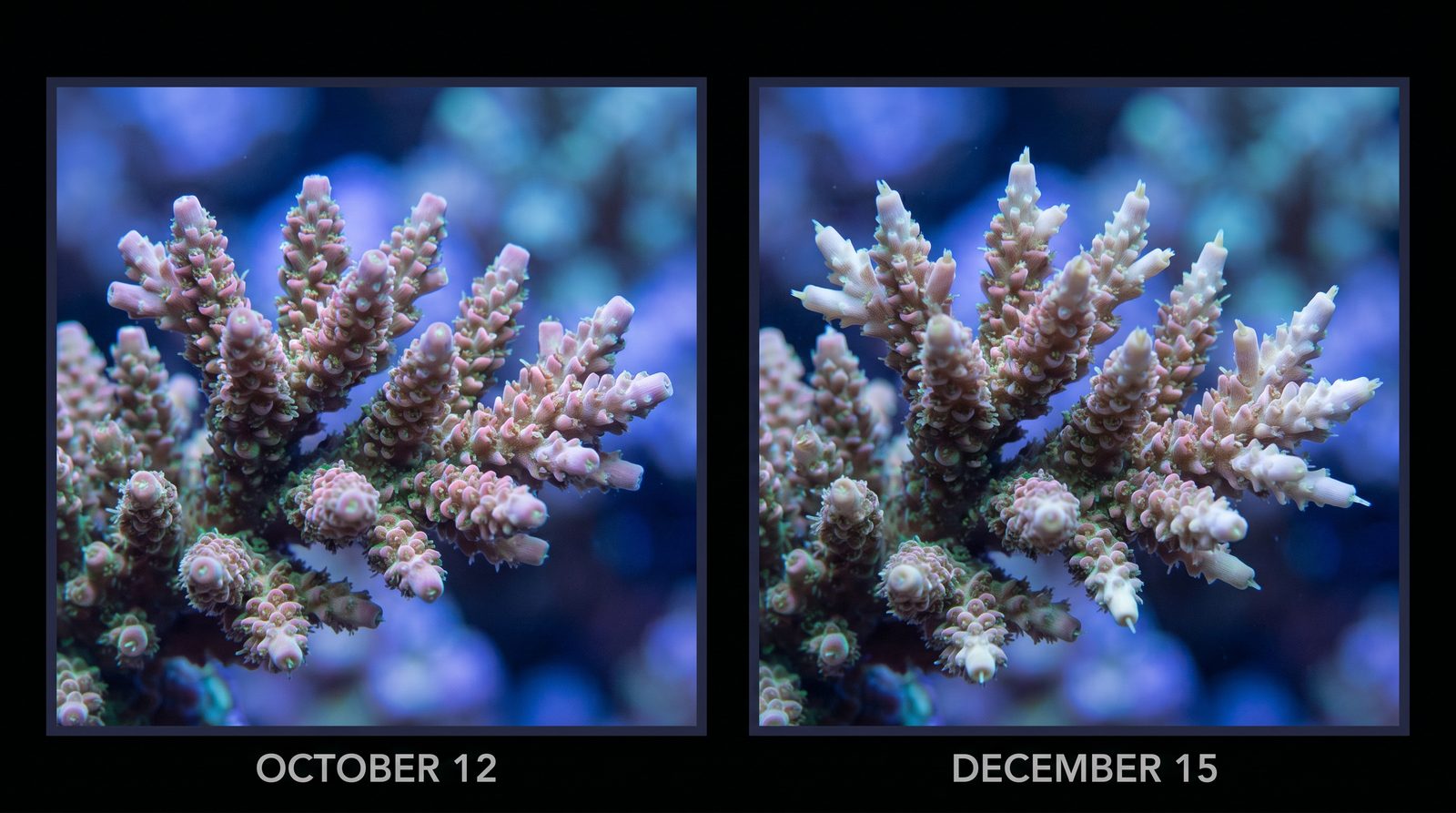
Tracking coral growth — through dated photos from consistent angles, placement and acquisition notes, and parameter logs — is one of the most useful practices in reef keeping. Growth is a leading health indicator: a colony that has stopped extending new tips is telling you something weeks before tissue recession or colour loss becomes visible. Correlating growth records with your parameter history is also the fastest way to identify what conditions your corals actually thrive under.
Reef keeping generates a lot of data — parameter tests, water changes, equipment adjustments — but one of the most informative signals is one most hobbyists never write down: how fast their corals are growing. Growth rate is not just a vanity metric. It is a leading indicator of tank health, a guide for fragging decisions, and, over months and years, the most honest record of whether your husbandry is actually working. A coral that stalls is telling you something before any test kit confirms it.
Why growth rate is a leading health indicator
Most reef keepers notice a problem when it becomes visible: pale tissue, recession, a closed clam. By that point, the underlying cause has often been present for weeks. Growth rate tends to slow earlier than colour fades and much earlier than tissue recedes. An SPS colony that was extending 2–3 mm of new tip every week and has now stopped extending for a fortnight is giving you a clear signal — even though it still looks fine to the eye.
This is why a growth record paired with a parameter log is far more useful than either one alone. When growth stalls, you can look back through your alkalinity log and ask: did anything change two or three weeks before this? Very often the answer is yes — a swing in alkalinity, a drop in nutrient levels, a period of elevated temperature. The correlation does not prove causation, but it gives you a direction to investigate.
What to record for each coral
You do not need sophisticated equipment to track coral growth. The most useful records are simple to gather and require nothing more than a phone camera and a few written notes.
| Data point | What to record | Why it matters |
|---|---|---|
| Acquisition date | Date purchased, traded or fragged | Sets the baseline; lets you calculate total growth time. |
| Source and name | Vendor or hobbyist name, species or trade name | Useful if you need to research husbandry or resell frags. |
| Placement | Rock number or position description, approximate depth | Allows consistent photo framing; helps if you need to relocate the coral. |
| First polyp extension date | Date you first observed polyps opening | A key acclimation milestone, often missed when not logged. |
| Dated photo | Photo from same angle, same approximate lighting | The primary growth reference — compare tip extension and tissue coverage. |
| Periodic observations | Free-text notes at each session | Record anything unusual: closed polyps, colour shift, aggression from neighbours. |
The dated photo method
A photograph taken today and compared with one taken three months ago will show you more than any ruler. The technique works best when you standardise your conditions: shoot from the same position relative to the tank, use the same white balance or colour mode, and photograph at roughly the same time of day so the photoperiod stage — and therefore the degree of polyp extension — is consistent.
When reviewing photos, look for four things: the reach of new growth tips beyond where they were in the previous image; the density of polyp coverage on existing branches; the overall colour saturation of the tissue; and whether any areas show recession or bleaching at the tips or base. Zooming in on the same region across a sequence of photos makes subtle changes obvious.
Correlating growth with parameter stability
The most instructive exercise a reef keeper can do is lay a growth timeline next to a parameter trend chart and look for coincidences. In practice this means noting in your log whenever you spot accelerated growth or a growth stall, and then looking backwards at what your parameters were doing in the weeks before.
Alkalinity variability is the most common culprit when SPS growth stalls. A tank held at a steady 8.5 dKH will often outgrow a tank that averages the same figure but swings between 7.5 and 9.5. The coral is not responding to the average — it is responding to the extremes and the rate of change. If you see this pattern in your own logs, the fix is not raising your alkalinity target; it is reducing the variance around whatever target you choose.
Nutrients tell a similar story. A sustained drop in nitrate and phosphate — often the result of over-skimming or aggressive carbon dosing — can slow growth and fade colour months before you notice it on the glass. If your growth log shows a stall and your parameter log shows nutrients that have been trending toward zero, the connection is worth investigating before you assume a different cause.
Fragging decisions and the growth record
A growth log also tells you when a coral is ready to frag. Rather than guessing based on visual size, you can see how fast a colony has grown over a known period and predict how long it will take to recover after fragging. Colonies that have been in a stable growth phase for several consecutive months handle fragging better than those that have only recently settled in or that show a recent slowdown.
Over time, a growth log becomes a documentation of your reef's development that no single photo or test result can replicate. The record of what was placed where, when it first extended polyps, how it responded to each parameter adjustment, and how it looked three months versus three years in — this is the kind of institutional knowledge about your own system that makes every decision easier and every problem faster to diagnose. It is also, for many reef keepers, one of the most satisfying parts of the hobby.
Add your first coral entry in ReefDeck
ReefDeck lets you log each coral with dated notes, link observations to your parameter history, and build a growth record that spans the life of your tank — all offline, all yours.
Open ReefDeck — it's free → Works on phone and desktop · installs as an app · exports to CSV anytimeFrequently asked questions
How do I track coral growth without measuring equipment?
Dated photos taken from a consistent angle are the most practical method. Use a fixed reference point in the frame — a rock edge, a frag plug, or an adjacent coral — and compare the coral's reach against that reference across successive photos. No ruler needed.
How often should I photograph my corals to track growth?
Monthly is a useful minimum for SPS; every two to three months is sufficient for slower-growing LPS and soft corals. The key is consistency: same angle, same time of day, same lighting mode. A photograph taken under inconsistent conditions is harder to compare than one taken monthly under standardised ones.
Why has my coral stopped growing?
Growth stalls most commonly follow alkalinity instability, a sustained drop in nutrients, a period of elevated temperature, or insufficient light reaching the colony. Going back through your parameter logs for the three to four weeks before the stall often reveals the cause. If logs are absent, that absence is itself a clue: tanks without consistent records tend to develop silent drifts that go unnoticed until symptoms appear.
Does faster growth mean a healthier coral?
Growth is a positive sign, but rate alone is not the full picture. Rapid growth under poor water conditions can produce brittle, poorly calcified skeleton. What you are looking for is consistent growth accompanied by good colour saturation, full polyp extension and stable tissue coverage — all of which are visible in a dated photo series and correlatable with your parameter log.