 ReefDeck
Open the free logbook
ReefDeck
Open the free logbook
Reading Reef Parameter Trends: Spotting Problems Before They Happen
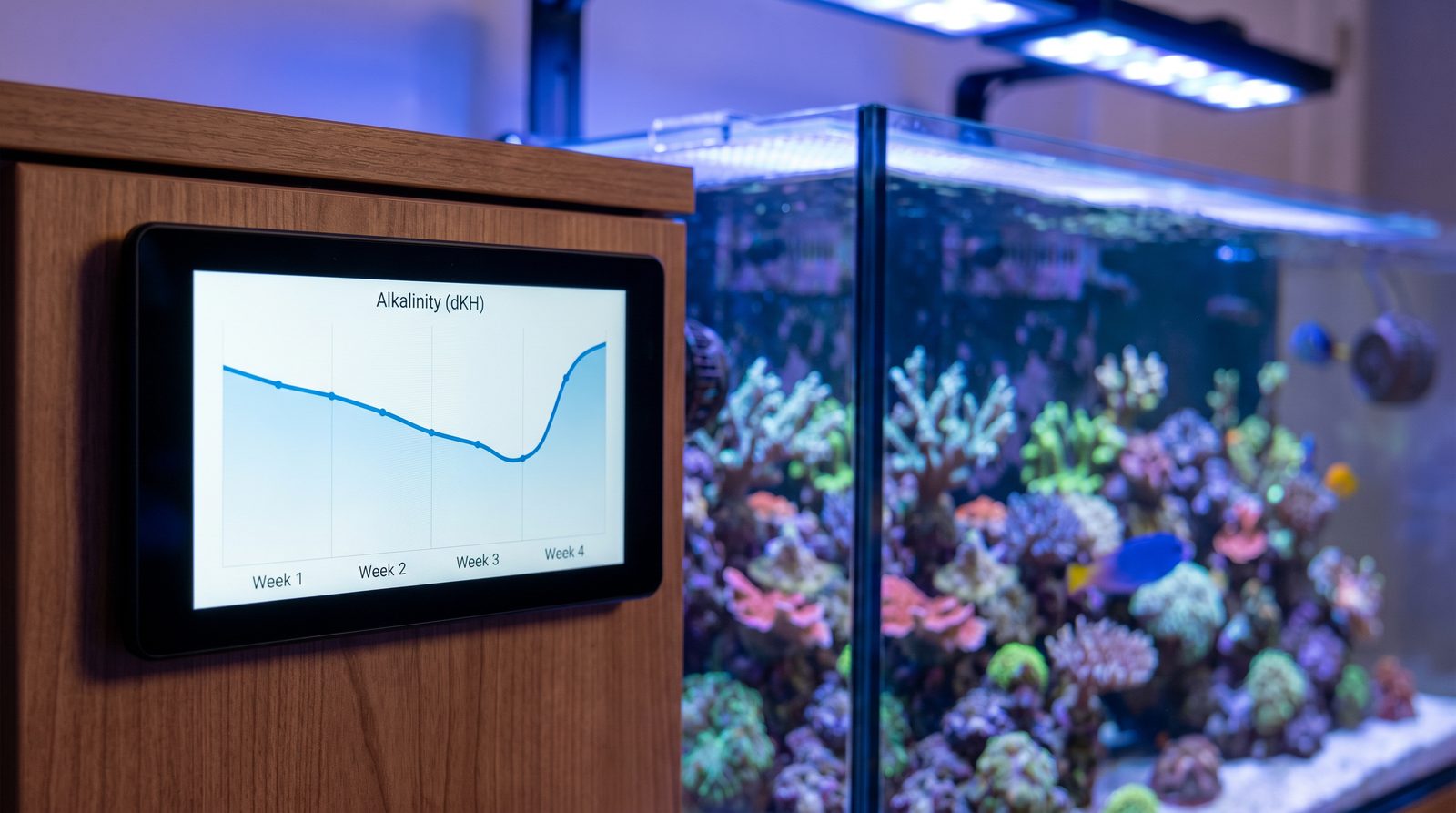
A parameter reading only tells you where a value is right now — a trend tells you where it is going. Alkalinity at 8.2 dKH is meaningless without knowing whether it was 9.0 last week or 8.1. The practical skill in reef keeping is learning to read the slope of your parameter logs: how fast a value is moving, in which direction, and when it will cross your safe band if nothing changes. That forecast — not the reading itself — is what lets you act before corals are stressed.
Most reef-keeping advice talks about target ranges: keep alkalinity between 7 and 11 dKH, calcium between 380 and 450 ppm, salinity at 1.025. That framing is not wrong, but it is incomplete. It treats each test result as a verdict — pass or fail — when it is actually a data point in a continuous story. The skill that separates reefers who catch problems early from those who deal with emergencies is the ability to read that story.
The difference between a reading and a trend
Consider two tanks. Tank A tests alkalinity at 8.2 dKH on a Friday. Tank B also reads 8.2 dKH on a Friday. Same number, entirely different situations.
Tank A's previous readings were 8.3, 8.2, 8.3, 8.2 — it has been stable for weeks and 8.2 is simply where this tank runs. No action needed. Tank B's previous readings were 9.0, 8.8, 8.5, 8.2 — a consistent drop of about 0.3 dKH per test over three weeks. At that rate Tank B will be at 7.0 dKH within a fortnight. Same number on Friday; completely different story. The only way to know which tank you are running is to look at more than one data point.
Slope: reading the rate of change
Slope is the rate at which a parameter is changing per unit of time. It is the single most useful thing your log can show you. A slope of −0.1 dKH per day on alkalinity means you are losing about 0.7 dKH per week — fine for a lightly stocked system, alarming for a tank running at 8.0 dKH with no headroom.
You do not need to calculate slope formally. Looking at three or four readings on a chart gives an immediate visual impression of direction and speed. What you are training yourself to notice is not "is this number in the target range" but "is this number moving, and how fast." A value in the middle of the range but moving quickly is often more concerning than a value near the edge of the range that has been stable for a month.
Consumption: what your slope tells you about your tank
On a growing reef, alkalinity and calcium slopes are not noise — they are signal. They tell you how fast your corals are calcifying. A faster alk drop means more growth (or a problem with your dosing). A slope that suddenly steepens tells you something changed: a new coral was added, a dosing pump failed, or your tank hit a growth spurt. A slope that suddenly flattens might mean corals stopped growing — which is sometimes a sign of stress before you can see it visually.
Tracking consumption over time also lets you calibrate your dosing more precisely than any calculator can. If your alk consumption is consistently 0.2 dKH per day over a month, you know exactly how much two-part or kalkwasser you need. When that consumption rate changes — and it will, as corals grow — you see it in the log before the parameter leaves the safe band.
| What the trend looks like | What it probably means | Suggested response |
|---|---|---|
| Alkalinity falling slowly and steadily | Coral consumption exceeding dosing rate | Increase two-part or kalkwasser dose gradually; re-test in 2–3 days. |
| Alkalinity falling fast then levelling | Dosing pump blocked or ran dry, then fixed | Check equipment; verify the log matches any changes you made. |
| Alkalinity unusually stable after additions | New coral load too low to register, or corals stressed and not calcifying | Cross-reference coral behaviour; look for other stress indicators. |
| Nitrate rising week on week | Bioload increasing faster than export capacity | Increase skimmer output, reduce feeding, check refugium performance. |
| Phosphate falling while nitrate holds | Nutrient ratio imbalance; phosphate being stripped | Review GFO/carbon dosing; bottomed phosphate stresses colour. |
| Salinity creeping up daily | Top-off system not keeping pace with evaporation | Check ATO reservoir, float valve, and refill schedule. |
| pH lower than usual at the same time of day | Elevated CO₂ in the tank room (sealed house, winter) | Improve gas exchange; consider a refugium or CO₂ scrubber on skimmer. |
The forecast: how many days until a problem?
Once you are reading slope, a natural next step is forecasting: if nothing changes, when will this value cross the edge of my safe band? This is simpler than it sounds. If your alkalinity is at 8.5 dKH and falling at 0.15 dKH per day, and your lower comfort limit is 7.5 dKH, you have roughly seven days before action becomes urgent. That is a week of breathing room — more than enough to adjust dosing calmly.
Compare that to a reefer who tests once a week and finds alkalinity at 7.2 dKH on Sunday — already below the comfortable floor, already potentially stressing corals, requiring rapid correction which itself carries risk. The data was always there; the only difference is whether it was being read as a trend or as an isolated snapshot.
Correlating parameters across time
Some of the most useful insights in reef keeping come from comparing two parameter trends side by side. Alkalinity and calcium should move roughly in proportion; if one is falling faster than the other, you may have a chemistry imbalance or a precipitation event. Nitrate and phosphate should move together; if phosphate crashes while nitrate stays elevated, the zooxanthellae in your corals are getting the wrong ratio and colour will suffer.
Correlating a parameter trend with an event — "nitrate spiked exactly two weeks after I added the large torch coral" — is only possible if you have dates on every reading and a note field for events. A log that captures both the numbers and the context is the one that will actually teach you how your specific tank behaves.
Building the habit of trend reading
Trend reading is not a complex skill, but it requires consistent data. A log with three months of twice-weekly alkalinity readings is an extraordinarily powerful document — you will know your tank's consumption rate by season, by coral load, and before and after any change you made. Every time you enter a test result, you are adding one more point to a picture of your tank's health that no single measurement could ever show. Log consistently, review the chart weekly, and act on slope rather than snapshot. That discipline is what keeps a reef stable through the changes a year inevitably brings.
Turn your test results into a trend chart automatically
ReefDeck plots every parameter you log as a time-series chart the moment you enter the numbers. Set your own safe band and see at a glance when a value is drifting — free, offline, no account required.
Open ReefDeck — it's free → Works on phone and desktop · installs as an app · exports to CSV anytimeFrequently asked questions
What is the difference between a parameter reading and a trend?
A reading tells you the current value of a parameter at one moment in time. A trend shows you the direction and rate of change across multiple readings. Alkalinity at 8.2 dKH is a reading; alkalinity that has dropped from 9.0 to 8.2 over two weeks is a trend — and that trend tells you far more about the tank's needs than the number alone.
How do I calculate my alkalinity consumption rate?
Subtract the lowest recent reading from the highest, then divide by the number of days between those two tests. For example, 9.0 dKH on Monday and 8.4 dKH on Friday is a drop of 0.6 dKH over four days, or 0.15 dKH per day. Tracking this rate over weeks lets you calibrate your dosing to exactly what your corals are consuming.
Why does my alkalinity look stable on a weekly test but crash unexpectedly?
Weekly testing only gives you one data point per seven days, which is not enough resolution to see a slope developing. A tank consuming 0.15 dKH per day will lose over 1 dKH between tests, but if the first test happened to catch it near the top of the cycle and the next near the bottom, the crash looks sudden when it is actually a week-old trend. Testing 2–3 times per week and logging the results makes these slopes visible before they become emergencies.
Should I correct a parameter immediately when it starts to drift?
Not always. A stable, gentle drift that has been consistent for weeks may simply be your tank's normal pattern — adjusting it creates more disruption than leaving it alone. Act when the slope is steepening, when a value is approaching the edge of your safe band, or when you can correlate the drift with a specific change in the tank. Observe for at least two or three test cycles before making any dosing adjustment in response to a trend.