 ReefDeck
Open the free logbook
ReefDeck
Open the free logbook
How Often Should You Test Your Reef Tank?
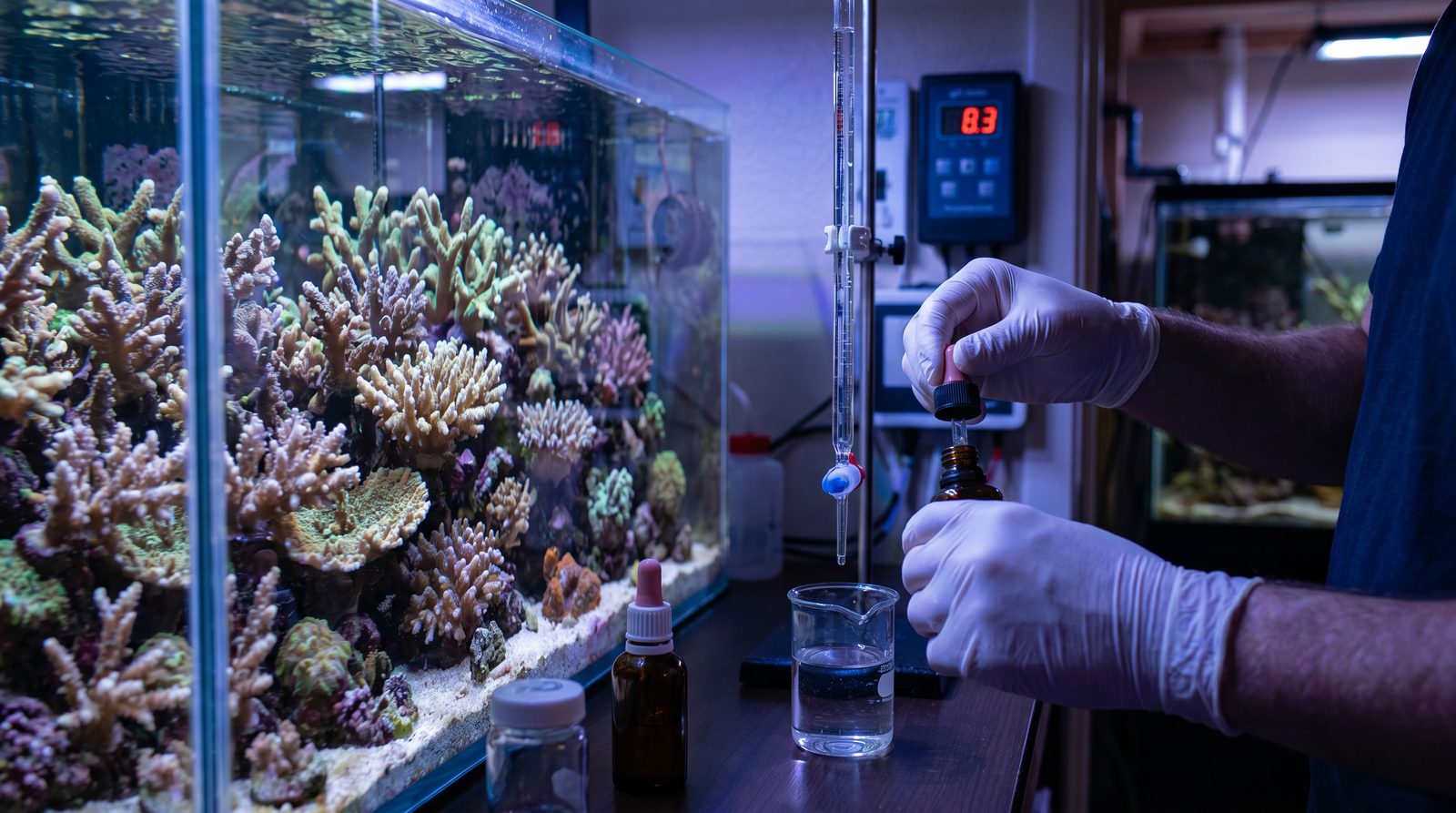
On an active reef, test alkalinity 2–3 times a week, calcium and magnesium once a week, and nitrate and phosphate once a week. Check salinity and temperature daily (a quick glance at a refractometer and thermometer is enough). Ammonia and nitrite only need testing during the cycling phase or after a large die-off. The exact frequency matters less than the consistency — regular tests at the same times give you a trend you can act on.
One of the most common questions new reef keepers ask is how often they actually need to test. Test too rarely and a slow alkalinity slide will go unnoticed until corals start receding. Test obsessively every day and you burn through reagents and, worse, start making knee-jerk dosing corrections to natural noise. The answer is a tiered schedule that matches each parameter's rate of change — some need attention several times a week, others can wait for a fortnight.
The testing frequency table
The frequencies below suit a mixed reef of LPS and SPS under moderate coral load. A lightly stocked softie tank can stretch every interval; a heavily stocked SPS system with rapid alk consumption may need to shorten them.
| Parameter | Recommended frequency | Why this often |
|---|---|---|
| Alkalinity (KH) | 2–3 × per week | Fastest-moving parameter; corals consume it continuously and a 1 dKH swing in 24 h is enough to stress SPS. |
| Calcium | Once a week | Moves more slowly than alk; weekly is enough to catch drift before it causes issues. |
| Magnesium | Once a week (or fortnightly on stable tanks) | Changes slowly; monthly is acceptable once you have a steady baseline established. |
| Nitrate (NO₃) | Once a week | Nutrient balance affects colour and algae; weekly keeps you aware of loading trends. |
| Phosphate (PO₄) | Once a week | Pairs with nitrate; test both together for meaningful ratio tracking. |
| Salinity | Daily (quick glance) | Evaporation concentrates salt fast; a 30-second refractometer check catches drift before it compounds. |
| Temperature | Daily (check display or thermometer) | Seasonal shifts and chiller/heater failures show up quickly; verify even if you have a controller. |
| pH | Continuous if possible, otherwise 2–3 × per week | Natural diurnal swings are normal; logging the pattern reveals CO₂ problems and refugium performance. |
| Ammonia / Nitrite | Daily during cycling; after die-offs otherwise | Should be zero on an established tank; only investigate if you suspect a crash. |
Why alkalinity needs the most attention
Alkalinity sits at the centre of the schedule because it is the parameter most likely to hurt your corals fastest. Unlike calcium or magnesium, which shift over days, alkalinity can drop by a full dKH overnight in a busy SPS system. A single weekly test could mean you catch a problem only after seven opportunities to cause damage.
The goal of 2–3 tests a week is not to adjust every time — it is to build enough data points to see the slope. If Monday reads 8.5 dKH and Wednesday reads 8.3, your consumption rate is roughly 0.1 dKH per day and you are fine. If Wednesday reads 7.9 you know something changed: coral load, dosing pump, temperature. You catch that story in a week rather than a month.
Calcium, magnesium and the slow movers
Calcium and alkalinity are linked — when alk goes up, calcium tends to edge down, and vice versa. Because calcium moves more slowly, a weekly test is genuinely sufficient in most tanks. The number to watch is not the reading itself but whether it is drifting away from the 380–450 ppm band over successive weeks.
Magnesium is the slowest of the three. On a tank with no obvious imbalance, testing fortnightly is reasonable. Where it matters most is when you cannot understand why alkalinity and calcium keep falling out of ratio — checking magnesium often reveals it has quietly slid below 1250 ppm, which prevents the other two from staying in solution properly.
Nutrients: nitrate and phosphate
Test these together, once a week. The individual numbers matter less than their ratio — roughly 16:1 nitrate-to-phosphate by weight is the Redfield ratio that zooxanthellae prefer, and if one parameter bottoms out while the other stays elevated, you will see colour issues and nuisance algae even if neither reading looks alarming on its own.
If your nutrient levels are stable week after week, fortnightly testing is a reasonable economy. If you are running a skimmer, refugium, or carbon dosing and actively managing export, stick to weekly — those systems can shift nutrients faster than a stable reef would naturally.
Salinity and temperature: the daily glance
These two do not need formal testing every day — a quick check is enough. Salinity creeps up as water evaporates (salt does not evaporate, only water does), so glancing at a refractometer or a calibrated probe each morning keeps you ahead of it. Temperature matters for the same reason: a heater fault or a warm spell can push your tank to dangerous levels before any other parameter registers a change. If you have an apex controller or similar, the daily glance is even quicker — but still worth doing rather than trusting it blindly.
The case for logging every test
A testing schedule only pays off if you record the results. Writing them down — or entering them into a logbook — transforms isolated measurements into a trend. An alkalinity reading of 8.1 dKH means almost nothing in isolation. A column of readings over three weeks that shows a slow, steady decline tells you your dosing is undercompensating for growth. That story is invisible without a log, and catching it early is the difference between a proactive tweak and a stressed-coral emergency.
Log every test in seconds, see the trend instantly
ReefDeck is a free, offline reef logbook — open it on your phone while you test, tap in the numbers, and your parameter history builds itself. No account needed, and your data stays yours.
Open ReefDeck — it's free → Works on phone and desktop · installs as an app · exports to CSV anytimeFrequently asked questions
How often should I test alkalinity in a reef tank?
Test alkalinity 2–3 times per week on an active mixed reef or SPS-dominated tank. Alkalinity is the fastest-moving parameter and can fall by 1 dKH per day on a heavily stocked system, so a weekly test alone leaves too much room for undetected drift.
Do I need to test every day?
Not for most parameters. A daily glance at salinity (refractometer) and temperature is good practice, but formal chemical testing every day creates more noise than insight for established tanks. Stick to the tiered schedule — frequent for alkalinity, weekly for calcium, magnesium and nutrients.
How often should I test nitrate and phosphate?
Once a week is the right rhythm for most tanks. Testing both on the same day lets you track the ratio between them, which matters as much as either absolute number. If nutrients are very stable, fortnightly testing is acceptable.
When can I reduce my testing frequency?
Once a tank has been running for 6–12 months with stable parameters and a dialled-in dosing or two-part routine, you can relax slightly — fortnightly magnesium, for instance, is reasonable. But alkalinity should always be checked at least twice a week on a reef with any significant SPS growth.