 ReefDeck
Open the free logbook
ReefDeck
Open the free logbook
Why Corals Lose Their Colour (Parameter Causes and Fixes)
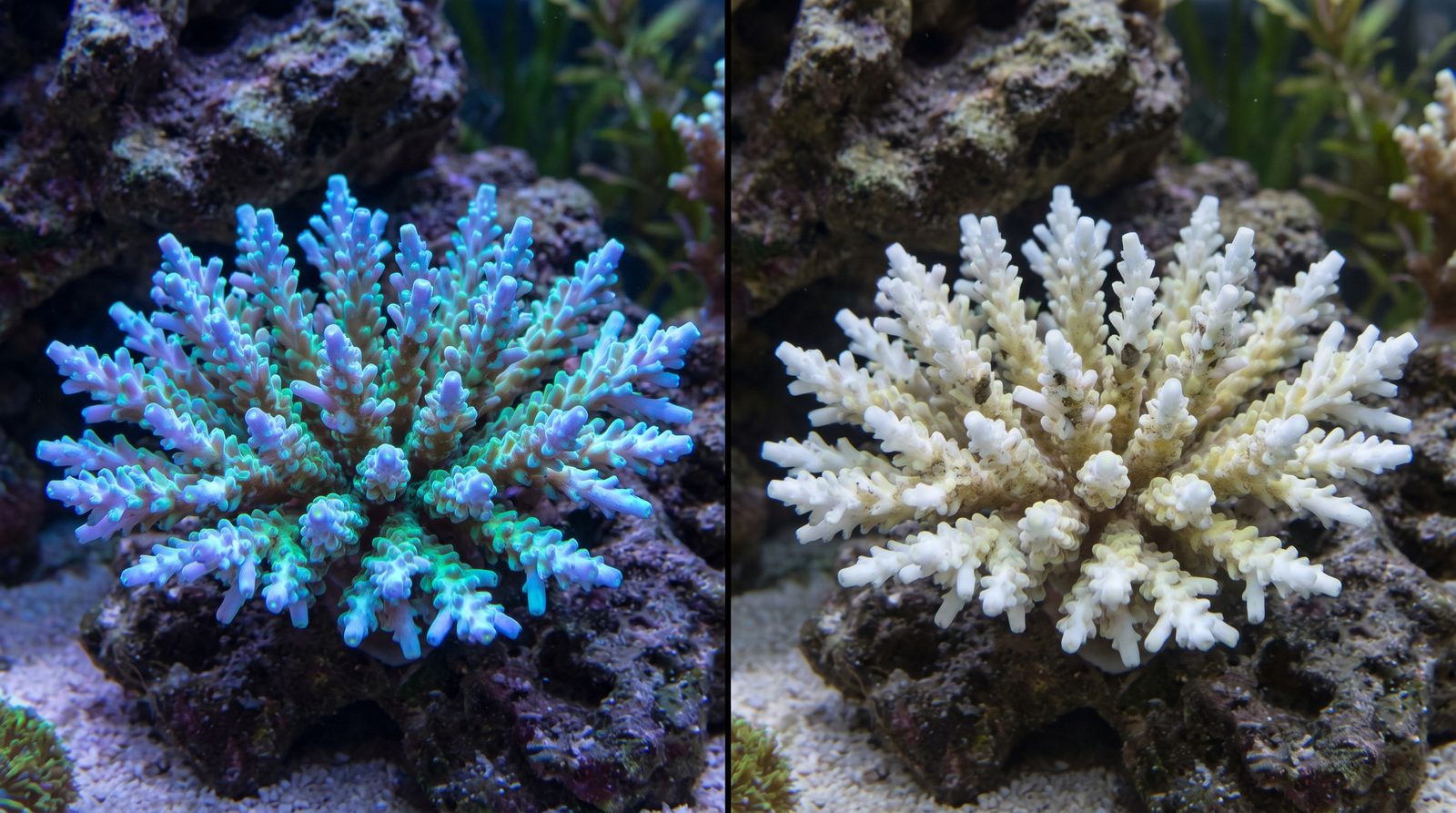
Coral colour loss is nearly always a water chemistry signal. Bleaching (white) points to temperature spike, light shock, or sustained parameter stress. Fading to pastels usually means nitrate and phosphate are too low. Browning means nutrients are too high relative to light. In all cases, the diagnosis starts with checking your parameter log for trends over the past two to four weeks — a single reading rarely tells the whole story.
A colour change in a coral is rarely sudden — it builds over days or weeks, driven by shifts in the water that the coral is reacting to before you notice. By the time bleaching is obvious, the stressor has usually been present for a while. Understanding the pattern of colour loss is the fastest path to diagnosing the cause.
Three distinct colour-loss patterns
Not all colour loss looks the same, and the differences matter. Bleaching, browning, and fading to pale pastels each point toward different causes and require different responses.
Bleaching (white tissue)
True bleaching means the coral has expelled its zooxanthellae. The tissue is transparent, revealing the white calcium carbonate skeleton underneath. This is a stress response — the coral is not dead, but it has lost the symbiotic algae it depends on for the majority of its energy. Common causes include a rapid temperature spike (above 28–29 °C sustained), sudden intense light exposure, a sharp alkalinity swing, or prolonged combination stress from multiple parameters drifting simultaneously.
Fading to pale pastels
When a coral retains its tissue shape and extension but shifts from vibrant colour toward washed-out, pale versions of the same tones, the zooxanthellae are still present but at reduced density. This is the characteristic look of nutrient starvation: nitrate and phosphate have dropped too low to sustain healthy zooxanthellae populations. The coral is not dead and not bleaching — it is hungry. SPS corals show this most dramatically because their pigmentation relies heavily on the density and health of their zooxanthellae.
Browning
Browning is the opposite: zooxanthellae have proliferated beyond normal density, masking the coral's own pigments with their brown colour. This typically happens when nutrient levels are higher than the light intensity can process — either nutrients have climbed, light has decreased, or both. A coral that was bright under strong light will often brown under the same nutrients if the light degrades (ageing bulbs, salt creep on lens panels, heavy shade from equipment). Browning is generally less urgent than bleaching but still indicates the system is out of balance.
The parameter causes behind each pattern
| Colour pattern | Most likely cause | Where to look first |
|---|---|---|
| White bleaching | Temperature spike, alkalinity swing, or light shock | Temperature log, alkalinity over past 2 weeks, any recent light change |
| Pale/pastel fading | Nitrate and/or phosphate too low | NO₃ and PO₄ readings — are they detectable? |
| Browning (all over) | Nutrients high relative to light | NO₃/PO₄ trend and light schedule or bulb age |
| Browning (tips only on SPS) | Insufficient light reaching tips | Light intensity, shading from equipment or other corals |
| Patchy or rapid bleaching | Bacterial infection or tissue necrosis (RTN/STN) | Inspect for spreading white line; isolate if needed |
How alkalinity swings drive colour loss
Alkalinity instability deserves its own mention because it is the single parameter most likely to cause coral stress without an obvious single-reading anomaly. A tank that swings between 7 dKH on Monday and 10 dKH on Thursday — both within the "acceptable" range — will show more tissue stress and colour loss than a tank held at a stable 8.5 dKH, even if the swinging tank looks fine in isolation. Corals regulate their calcification chemistry against a stable alkalinity baseline; rapid shifts disrupt that process and the zooxanthellae relationship suffers.
Diagnosing by tracking trends, not single readings
The most useful diagnostic question is not "what is the parameter today?" but "where has it been over the past two to four weeks?" A coral that started fading ten days ago but only gets tested today can point you back to whatever shifted around day ten — a change in feeding, a skimmer adjustment, a water change with a slightly different salt, a power outage that warmed the tank. Without a dated log, that context is gone.
When you start logging parameters consistently — alkalinity, nitrate, phosphate, temperature — and recording them alongside dated observations of your corals' appearance, colour changes stop being mysteries. They become data points in a timeline. Logging in ReefDeck lets you add a note alongside each test entry, so you can mark the day you noticed the first hint of fading and then look back at the parameter trend that preceded it.
Catch colour trends before they cost a colony
ReefDeck logs every parameter with a timestamp and shows them as charts. When a coral starts fading you can scroll back and see exactly when the drift began. Free, offline, no account needed.
Open ReefDeck — it's free → Works on phone and desktop · installs as an app · exports to CSV anytimeFrequently asked questions
Why has my coral turned pale or white?
Pale fading (pastel tones, tissue still intact) usually means nitrate and phosphate are too low — check if both are undetectable. White bleaching with translucent tissue means the coral has expelled its zooxanthellae, typically from a temperature spike, sharp alkalinity swing, or sudden light change. Check your parameter log for any movement in those values over the past two weeks.
Why is my coral turning brown?
Browning means zooxanthellae have proliferated, masking the coral's pigmentation. The most common cause is nutrients rising above what the available light can process — check nitrate and phosphate levels and confirm your lights are running at full intensity (ageing bulbs and dirty lens panels are frequent culprits).
Can a bleached coral recover?
Yes, if the stressor is removed promptly. A partially bleached coral that retains most of its tissue can regain zooxanthellae over weeks to months given stable parameters, moderate lighting, and regular feeding. Full white bleaching with very little tissue remaining has a lower survival rate, but some corals do recover. Remove the stressor first, then focus on stability rather than trying to correct multiple parameters at once.
How do alkalinity swings cause coral colour loss?
Corals regulate calcification against a stable alkalinity baseline. Rapid swings — even within the target 7–11 dKH range — disrupt that chemistry and stress the relationship between coral and zooxanthellae. Colour loss from alkalinity instability often appears gradually over days and is easy to miss without a dated log of how much the value has moved, not just where it sits today.