 ReefDeck
Open the free logbook
ReefDeck
Open the free logbook
Nitrate and Phosphate in a Reef Tank: Finding the Balance
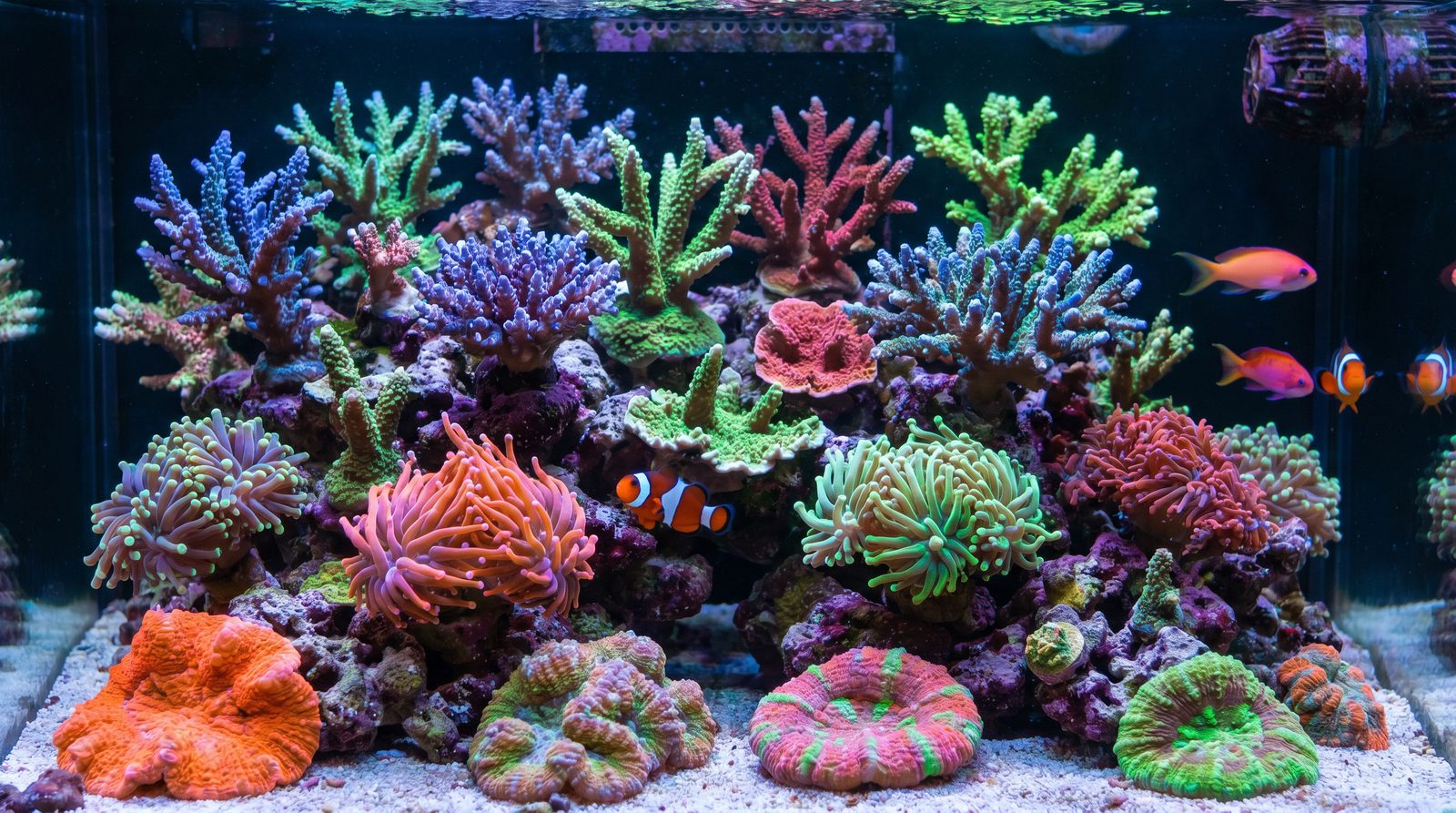
Nitrate and phosphate should not be zero in a reef tank. Corals need both as nutritional inputs, and bottomed-out nutrients drive pale tissue, stalled growth, and dinoflagellate blooms. Aim for 1–10 ppm nitrate and 0.03–0.10 ppm phosphate, and watch the ratio as closely as the individual numbers.
For years the reef-keeping hobby chased "zero nutrients" as the sign of a pristine system. The logic seemed sound: fewer nutrients, fewer algae. The reality is more nuanced — and ignoring it costs hobbyists corals. Nitrate and phosphate are not just waste products to export; they are food. Strip them out entirely and you do not have a pristine reef; you have a starved one.
Why corals need measurable nutrients
Corals are animals that host symbiotic algae called zooxanthellae in their tissue. The zooxanthellae photosynthesise and share energy with the coral, but like any plant they need nitrogen and phosphorus to function. When nitrate and phosphate drop below detectable levels, the zooxanthellae thin out and the coral's colour fades — from rich browns and greens toward pale pastels. Sustained starvation leads to bleaching, and in a tank with bottomed-out nutrients the first sign is often a dinoflagellate bloom filling the ecological niche that beneficial microbes can no longer hold.
This does not mean high nutrients are acceptable. Excess nitrate and phosphate fuel filamentous algae, cyanobacteria, and poor coral extension. The goal is a small but consistently measurable amount — not a race to zero, and not an excuse to under-skim.
Target ranges and what the numbers mean
| Parameter | Target range | Notes |
|---|---|---|
| Nitrate (NO₃) | 1–10 ppm | Lower end suits a lightly stocked SPS system; higher end is fine for a fish-heavy mixed reef. |
| Phosphate (PO₄) | 0.03–0.10 ppm | Below 0.02 ppm routinely causes colour loss and dino outbreaks. |
| NO₃ : PO₄ ratio | ~100 : 1 by mass | A rough guide; the individual values matter more than a precise ratio. |
The 100:1 nitrate-to-phosphate ratio by mass is a useful orientation point, not a hard law. A tank at 5 ppm NO₃ and 0.05 ppm PO₄ is well-balanced. A tank at 0.5 ppm NO₃ and 0.08 ppm PO₄ is phosphate-dominant — something many hobbyists encounter when they have heavy skimming but feed heavily — and that imbalance can cause its own stress on coral tissue over time.
Symptoms of too-low versus too-high nutrients
- Nitrate and phosphate too low: corals pale or bleach from inside out; new polyp extension poor; dinoflagellates appear (brown, snotty strands that pearl off, do not rub away like hair algae); coral growth stalls.
- Nitrate too high (>25 ppm): nuisance algae — hair algae, turf algae — accelerates; some SPS show reduced polyp extension; water can have a slight tint.
- Phosphate too high (>0.15 ppm): corals may bleach or lose vibrancy; calcification rates slow because phosphate binds to calcium carbonate and inhibits skeleton formation.
- Phosphate without matching nitrate: the phosphate-dominant scenario described above; expect stressed pigmentation even if nitrate reads acceptable.
How to raise nutrients gently
If your readings are consistently undetectable, the fix is almost always feeding more before reaching for an additive. Increase feeding frequency — more variety in frozen food and pellets raises both nitrate and phosphate together, keeping the ratio natural. Allow a little extra food to the tank rather than skimming it out immediately. Reducing skimmer output briefly can help. Targeted dosing products exist for raising nitrate specifically (dilute potassium nitrate solutions), but this is only worth considering in lightly stocked, heavily exported systems where feeding more is not practical.
How to lower nutrients gently
If nitrate and phosphate are climbing, begin with the basics before adding equipment or chemistry. Feed a little less, or feed the same amount but remove uneaten food before it dissolves. Ensure your skimmer is correctly sized and set. Regular water changes with quality salt mix help dilute both parameters gradually. Refugia with macroalgae — most commonly Chaetomorpha — provide continuous, gentle export as you harvest the algae. If those measures are insufficient, carbon dosing (adding a carbon source such as vodka, vinegar, or a commercial two-part equivalent) fuels bacteria that consume nitrate and phosphate as they multiply. Carbon dosing is effective but requires care: dose conservatively, watch for oxygen depletion, and always change in small increments.
The tool that ties all of this together is consistent logging. It is nearly impossible to spot a gradual nutrient drift — upward or downward — from a single test result. When you record both nitrate and phosphate on the same date, and do so every week, you see the trend: whether your current export and feeding habits are holding steady, slowly depleting, or slowly accumulating. ReefDeck records both values in a single log entry and plots them as trends, so the pattern that matters becomes visible over time.
Track both nutrients in one place
ReefDeck lets you log nitrate and phosphate alongside every other parameter, then shows them as a chart so you can see the ratio shifting before problems appear. Free, offline, no account needed.
Open ReefDeck — it's free → Works on phone and desktop · installs as an app · exports to CSV anytimeFrequently asked questions
Should nitrate and phosphate be zero in a reef tank?
No. Zero nutrients is one of the most common mistakes in reef-keeping. Corals and their zooxanthellae need both nitrate and phosphate as food. Undetectable levels cause pale colour, bleaching, stalled growth, and dinoflagellate blooms. Aim for 1–10 ppm nitrate and 0.03–0.10 ppm phosphate.
What is the ideal nitrate to phosphate ratio for a reef tank?
A rough guide is roughly 100:1 by mass — so around 5 ppm nitrate alongside 0.05 ppm phosphate. This mirrors the Redfield ratio used in marine biology. In practice, keeping both parameters within their individual target ranges naturally produces a workable ratio; chasing the ratio itself is less useful than testing both values regularly.
How do I lower phosphate in a reef tank?
Start with feeding less and checking that uneaten food is being removed. A well-sized skimmer and regular water changes will address moderate elevation. GFO (granular ferric oxide) in a reactor provides targeted phosphate removal. Avoid crashing phosphate quickly — a gradual reduction over several weeks is safer for coral tissue.
How do I raise nitrate if it is undetectable?
Increase feeding frequency and variety first — more frozen food and pellets naturally raise nitrate. Reduce skimmer intensity slightly if the system allows. In heavily exported systems with minimal livestock, dilute potassium nitrate solutions can be dosed carefully, but always test twice a week to track the trend and avoid overshooting.