 ReefDeck
Open the free logbook
ReefDeck
Open the free logbook
Dinoflagellates in a Reef Tank: Causes and Recovery
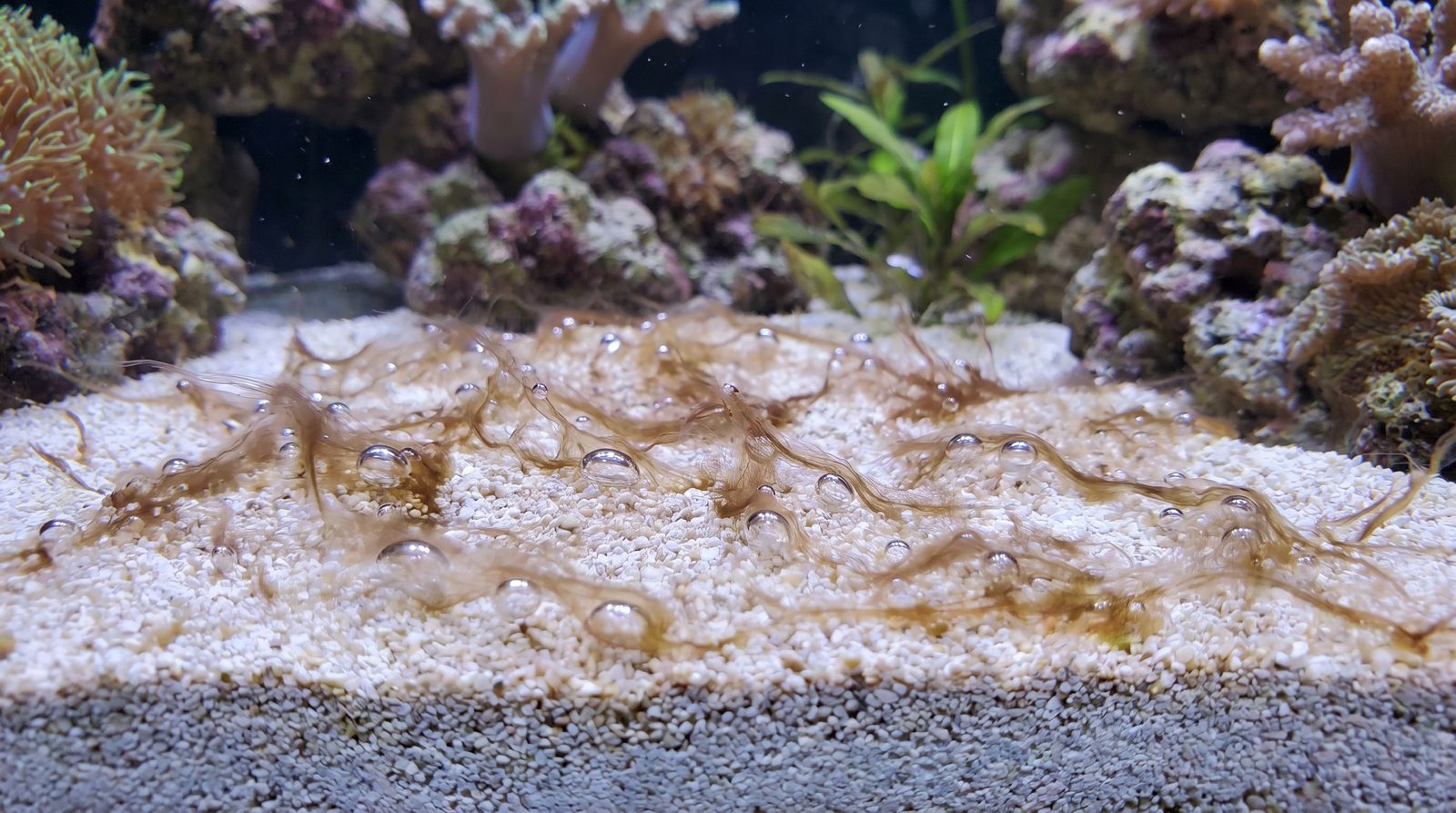
Dinoflagellates appear most often when nitrate and phosphate are undetectably low — a clean, over-exported tank starves the beneficial microbiome and gives dinos a competitive advantage. Recovery centres on raising nutrients to a detectable level (1–5 ppm NO₃, 0.03–0.06 ppm PO₄), adjusting the photoperiod, adding UV sterilisation, and manually siphoning while patience does the rest.
Few reef problems are as demoralising as a dinoflagellate outbreak. The sand disappears under brown film by morning; strands lift with bubbles in the afternoon light; you pull out what you can and it is back by the next day. The good news is that the underlying cause is well understood, and the fix — though slow — is consistent. Dinos thrive in a specific set of conditions, and dismantling those conditions is the entire game.
What dinoflagellates actually are
Dinoflagellates are single-celled protists — somewhere between algae and animal in classification — that exist in every reef tank in low numbers. Under normal conditions they are kept in check by competing bacteria and microalgae. When the competitive balance tips in their favour, they bloom. Several genera are common in reef tanks; some are merely unsightly, while others (notably Ostreopsis species) produce compounds that can irritate corals and, in heavy blooms, are worth avoiding contact with during manual removal.
How to tell dinos from other algae
The identification matters because the response differs. Dinos have a distinctive set of traits:
- Texture: stringy, snotty, or mucus-like rather than stiff or hair-like
- Bubbles: oxygen bubbles trapped within the strands cause them to pearl up and lift off the substrate during the light period — this is the single most diagnostic sign
- Colour: golden-brown to dark brown; not the bright green of hair algae or the purple-red of cyanobacteria
- Rub test: rubs off slickly without leaving a fuzzy tuft; hair algae leaves a tuft, cyano smears and leaves a film
- Morning vs evening: worst in the morning; partly clears or lifts by afternoon under light as photosynthesis produces bubbles
Why low nutrients drive dinoflagellate outbreaks
This is the part of dino biology that changed the hobby's understanding. For years, outbreaks were blamed on bad husbandry and high nutrients. The modern reef-keeping consensus points in the opposite direction: dinos are oligotrophic — they outcompete other organisms specifically in low-nutrient environments. A tank with undetectable nitrate and phosphate has starved out the bacteria and microalgae that would normally compete with dinos for space and dissolved organics, leaving a niche that dinos fill.
This is why dino outbreaks are most common in mature, heavily skimmed, lightly stocked systems that have been optimised for water clarity. The tank is clean, but it is too clean — the beneficial microbial ecosystem that keeps dinos in check has been hollowed out along with the nutrients.
The recovery approach
Recovery from a dino outbreak follows a consistent playbook. None of the steps is dramatically fast; expect two to six weeks of improvement before the tank stabilises. Do not attempt to fix everything at once — change one variable at a time and wait to observe the effect.
- Raise nutrients to a detectable level. This is the single most impactful step. Feed more — increase feeding frequency and variety. Reduce skimmer output if it is dialled to maximum. The target is 1–5 ppm nitrate and 0.03–0.06 ppm phosphate. Test twice a week and log every result so you can confirm the trend is moving.
- Adjust the photoperiod. A temporary reduction to 6–8 hours of full light (down from 10–12) deprives dinos of the light energy they need to photosynthesise and produce the oxygen bubbles that spread them. Do not go dark entirely — your corals still need light — but reducing intensity or duration buys time while the nutrient shift takes hold.
- Add UV sterilisation if available. A UV steriliser in the return or a separate loop reduces the free-floating dinoflagellate load in the water column and slows the rate of new colonisation. It does not eliminate dinos already on surfaces, but it reduces the pressure.
- Manual export daily. Siphon out as much visible material as you can each day before the lights come on (before bubbles cause lifting and spread). This reduces the colony size and slows reproduction. Discard the siphoned water outside the tank.
- Be patient. Nutrient adjustment alone takes one to three weeks to shift the competitive balance. The tank may look worse before it looks better as the raised nutrients also cause a brief algae flush. That is often a sign the recovery is working — beneficial microalgae are beginning to compete again.
Tracking your way through recovery
Dino recovery is slow enough that it is easy to lose confidence. Weekly photos of the sandbed alongside logged nutrient readings turn "I think it might be improving" into something you can actually see. When you log nitrate and phosphate twice a week during the recovery period, the upward trend from undetectable toward your target range becomes visible in a chart — and so does the point where dino coverage starts contracting. That cause-and-effect timeline, recorded in real time, is far more useful than memory when deciding whether to hold course or adjust the approach.
Log your way through the recovery
Dino recovery is a multi-week process where the trend matters more than any single reading. ReefDeck tracks your nitrate, phosphate, and observations in one timeline so you can see the recovery actually working. Free, offline, no account needed.
Open ReefDeck — it's free → Works on phone and desktop · installs as an app · exports to CSV anytimeFrequently asked questions
What causes dinoflagellates in a reef tank?
The most common cause is nitrate and phosphate dropping to undetectable levels, often in heavily skimmed or lightly stocked systems. Low nutrients deprive the competing bacteria and microalgae that would normally keep dino populations in check. Other contributing factors include a new tank without a mature microbiome, low flow, and sometimes a shift in light spectrum or intensity.
How do I get rid of dinoflagellates in a reef tank?
The core fix is raising nutrients to a detectable level — feed more and reduce skimmer output until nitrate reaches 1–5 ppm and phosphate 0.03–0.06 ppm. Alongside this, temporarily shorten your photoperiod, add UV sterilisation if possible, and manually siphon each morning before lights come on. Recovery typically takes two to six weeks and requires patience — the trend in your parameter log is the clearest sign it is working.
Are dinoflagellates dangerous to my fish and corals?
Most dino species found in home reef tanks are primarily a nuisance to the sandbed and rock. However, some species — particularly Ostreopsis — produce compounds that can irritate coral tissue and in very heavy blooms should not be handled without gloves. If corals are showing tissue recession or fish are behaving unusually, remove what you can daily and accelerate the nutrient-raising steps while consulting current reef-keeping community resources for the specific species if you can identify it.
How is a dino outbreak different from cyanobacteria?
Dinos are golden-brown, form stringy strands with trapped oxygen bubbles that lift off the substrate during the light period, and thrive in low-nutrient tanks. Cyanobacteria is usually red or purple, forms smooth sheets, and thrives in high-nutrient, low-flow conditions. The treatments are essentially opposite — raising nutrients for dinos, improving flow and reducing organics for cyano — so correct identification matters before you start.