 ReefDeck
Open the free logbook
ReefDeck
Open the free logbook
Cycling a New Reef Tank: The Complete Timeline
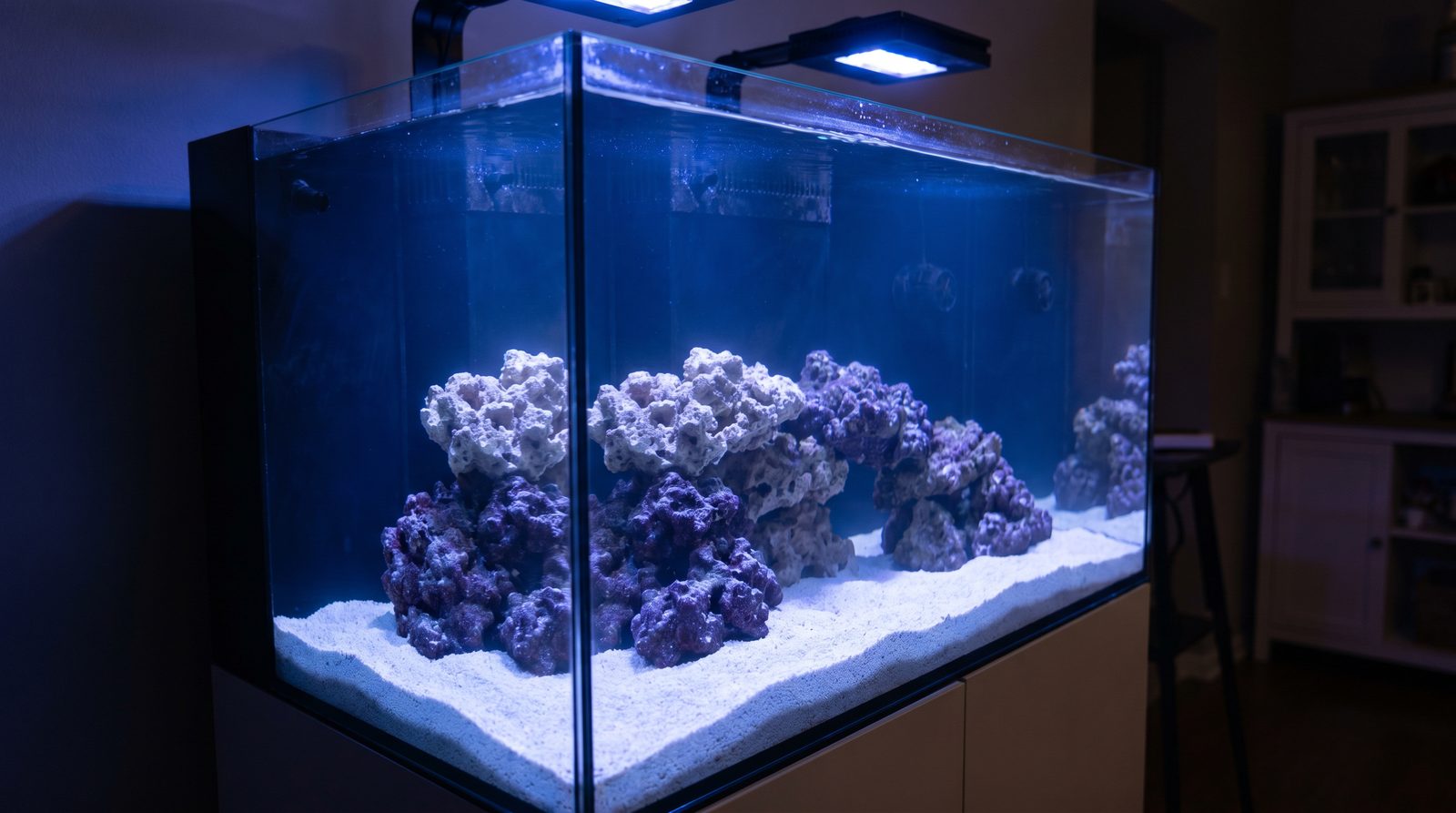
A new reef tank must establish a colony of beneficial bacteria that convert toxic ammonia → nitrite → nitrate. This typically takes four to eight weeks. The tank is ready for livestock only when ammonia reads zero, nitrite reads zero, and nitrate is detectable — confirmed by testing at least twice in the final week. Do not add livestock before this point.
Every reef tank begins as a sterile body of water with no ability to handle waste. Add a fish before the cycle is complete and the ammonia from its waste will reach lethal concentrations within days. The nitrogen cycle is not a suggestion or a shortcut to find — it is the biological foundation without which nothing else in reef-keeping works. Understanding it removes the guesswork from one of the most critical phases of setting up a reef.
What the nitrogen cycle is
The nitrogen cycle is the process by which colonies of bacteria convert fish waste and decomposing organic matter — which enters the water as toxic ammonia — into progressively less harmful compounds. The key players are two groups of bacteria:
- Nitrosomonas (and related genera) colonise live rock and substrate and convert ammonia (NH₃/NH₄⁺) into nitrite (NO₂⁻).
- Nitrospira and related genera then convert nitrite into nitrate (NO₃⁻), which is far less toxic and manageable through water changes and export.
Neither ammonia nor nitrite should ever be present in a tank with livestock. Both compounds damage gill tissue, suppress immune function, and kill fish and corals at concentrations that can build within days in an uncycled system. Nitrate at low levels (under 20–25 ppm) is tolerated well; the goal is getting it to that stable end-point.
The week-by-week timeline
Cycling timelines vary based on seeding method, temperature, live rock quantity, and the ammonia source used. The following is a typical progression for a tank seeded with live rock and a pinch of ammonia or a small piece of raw seafood:
- Days 1–3 (Setup): Saltwater mixed to 1.025, rock and sand placed, equipment running. Ammonia begins rising as organic matter from live rock starts decomposing. Test daily. Do not add livestock.
- Days 4–10 (Ammonia peak): Ammonia climbs — readings of 1–4 ppm are normal and expected. Nitrite reads zero. Nitrosomonas bacteria are establishing. Water may look murky or slightly cloudy. This is the start of the "ugly stage."
- Days 7–18 (Nitrite rise): Ammonia begins falling as the first bacterial colony establishes. Nitrite starts climbing, sometimes dramatically (2–5 ppm is possible). Ammonia may not fully zero yet. Nitrospira bacteria begin colonising. Do not add livestock.
- Days 14–28 (Nitrite peak and fall): Nitrite reaches its peak and begins declining as the second bacterial colony grows. Ammonia should now be at or near zero. Nitrate starts becoming detectable — this is the signal that the cycle is progressing correctly.
- Days 21–42 (Cycle complete): Both ammonia and nitrite read zero. Nitrate is detectable (typically 5–30 ppm depending on the ammonia source used). Confirm by testing on two separate days. If both read clean, the tank is ready for a cautious first addition of livestock.
- Days 42+ (Ugly stage): Some tanks experience diatom blooms, hair algae, or other nuisance growth after the cycle completes, as the microbiome continues to mature. This is normal. Continue water changes to reduce nitrate and wait for the tank to balance before adding sensitive corals.
What to test and how often
| Parameter | Cycle phase | Frequency | What you are looking for |
|---|---|---|---|
| Ammonia | All stages | Daily during weeks 1–2, then every 2–3 days | Rise then fall to zero |
| Nitrite | Week 1 onward | Daily during weeks 2–3, then every 2–3 days | Rise then fall to zero |
| Nitrate | Week 2 onward | Every 2–3 days | Detectable reading confirms cycle progressing |
| pH | All stages | 2–3 times a week | Should hold roughly 7.8–8.2; low pH can slow bacterial growth |
| Salinity | All stages | Every 2–3 days | Evaporation raises salinity in a new tank faster than expected — top off with fresh water |
How to speed up the cycle (without cutting corners)
The most reliable way to accelerate cycling is to seed the tank with established beneficial bacteria. Live rock from a healthy, disease-free donor tank carries significant bacterial populations in its porous structure. Commercial bacterial supplements — bottled nitrifying bacteria — have improved considerably and a quality product can meaningfully reduce cycle time. Using a filter sponge or media from an established system transfers bacteria even more directly. None of these eliminate the cycle; they give it a head start. Temperature helps too: bacteria grow faster in warmer water, and holding the tank at the upper end of the target range (26–27 °C) during the cycle is a common practice.
When the cycle is complete and what comes next
The cycle is complete when ammonia reads zero and nitrite reads zero on two tests at least 24 hours apart, with nitrate detectable. Do a large water change (30–50%) to reduce the accumulated nitrate from the cycling process before adding the first livestock. Start with the hardiest, most forgiving inhabitants and add slowly over several weeks — the bacterial colony will scale up with the bioload if you give it time to adjust. Jumping from an empty tank to a full reef in a week is how a cycled tank becomes a re-cycling tank.
Logging through the cycle gives you something beyond a decision point — it gives you a baseline. Your first weeks of data show you exactly what a healthy, low-load ammonia and nitrite trend looks like in your specific system. When something unusual happens months later — a sudden ammonia spike, a nitrite reading from nowhere — you have a clean reference to compare it against. That baseline, recorded in ReefDeck from day one, is the foundation every future troubleshooting session builds on.
Log every stage of your cycle
ReefDeck lets you record ammonia, nitrite, nitrate, and pH through every stage of the cycle. When the trend turns — and it does — you will see it in the chart rather than guessing from memory. Free, offline, no account needed.
Open ReefDeck — it's free → Works on phone and desktop · installs as an app · exports to CSV anytimeFrequently asked questions
How long does it take to cycle a new reef tank?
Typically four to eight weeks, depending on seeding method, water temperature, and how much live rock or bacterial supplement was used to start the tank. A tank seeded heavily with cured live rock and a quality bacterial supplement may show a complete cycle in three to four weeks; a fish-only cycle from scratch can take six to ten weeks. Confirm with two consecutive clean tests before adding livestock.
How do I know when my tank is cycled?
The tank is cycled when ammonia reads zero and nitrite reads zero, with nitrate detectable. Test on two separate days at least 24 hours apart to confirm both remain at zero — a single clean reading can be misleading. Nitrate being present confirms the second bacterial colony (converting nitrite) has established.
Can I add fish during the cycle?
No. Ammonia and nitrite at the concentrations typical during cycling — often 1–5 ppm — are acutely toxic to fish and corals. Adding livestock before both readings are zero risks rapid death from ammonia poisoning. The only exception is if you are using the "fish-in cycle" method deliberately with a single very hardy fish, which is generally not recommended for reef tanks.
Why is there an ugly stage after the cycle completes?
A newly cycled tank has a bacterial colony but not yet a mature, diverse microbiome. Diatoms (brown film on glass and sand), hair algae, and other nuisance growth commonly appear in the first four to eight weeks after cycling as the tank works through excess nutrients and organic material. This is normal and temporary — clean manually, do regular water changes, and avoid adding sensitive corals until the tank has settled, typically after two to three months.