 ReefDeck
Open the free logbook
ReefDeck
Open the free logbook
How to Track Reef Tank Parameters (and Why It Matters)
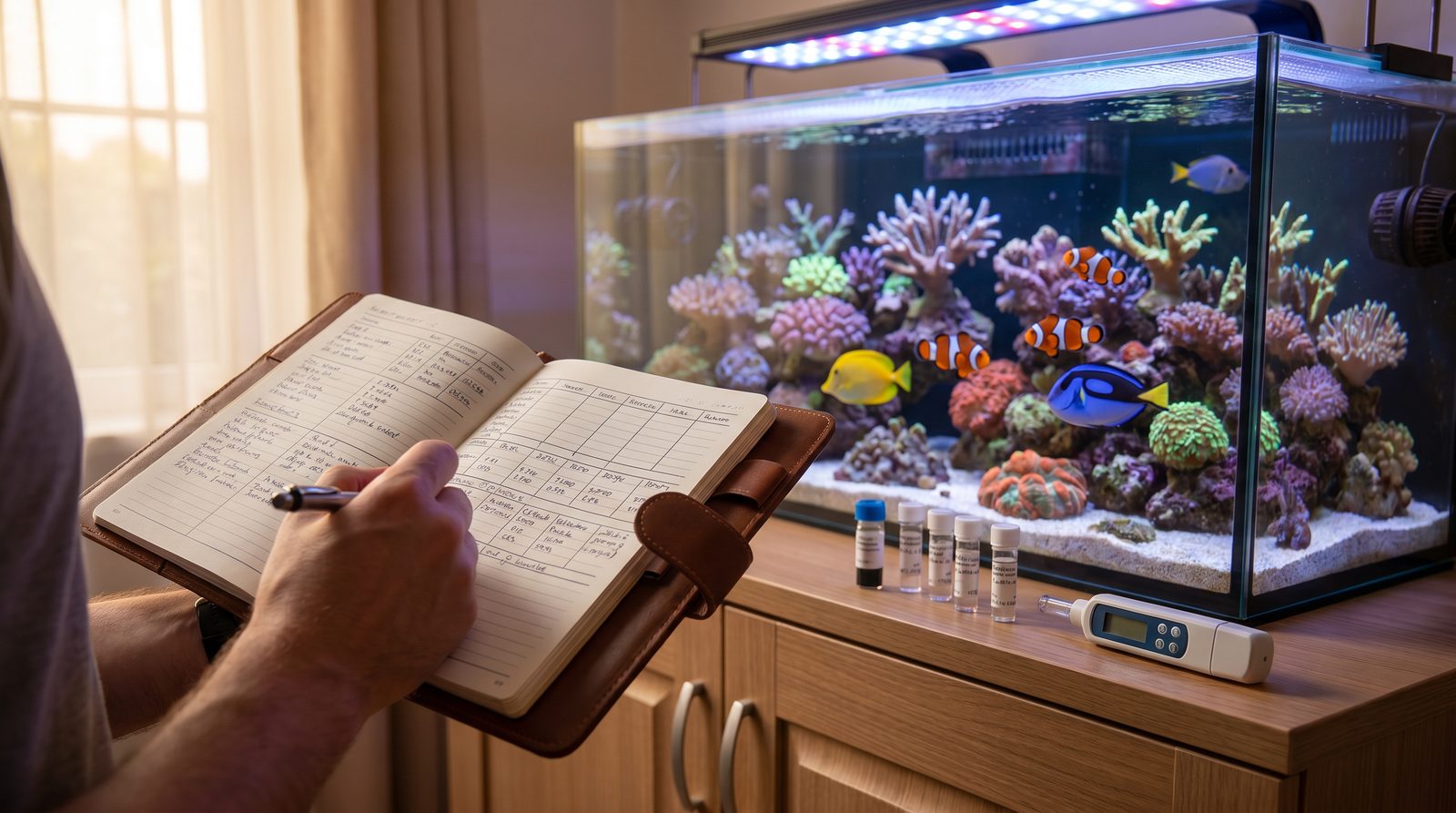
Track salinity, temperature, pH, alkalinity, calcium, magnesium, nitrate and phosphate — at minimum alkalinity 2–3 times a week, the rest weekly. Record every result with a date; a single reading tells you almost nothing, but a series of readings reveals whether your tank is stable, trending in the wrong direction, or recovering after a correction. The right tool is whichever one you will actually use consistently — a paper notepad, a spreadsheet, or a dedicated logbook app.
Ask an experienced reef keeper what separates tanks that thrive from tanks that crash, and the answer is almost never the equipment or the livestock list. It is the habit of recording. A reef tank does not announce problems — it accumulates them slowly, through small daily drifts in alkalinity, a creeping rise in nitrate, or a temperature that climbs a degree each summer afternoon. The moment you start logging every test result with a date, those slow drifts become visible. Problems that used to blindside you start giving you days of warning instead.
What parameters to track
The core list for a mixed reef covers eight parameters. Each one has a different job and a different urgency.
| Parameter | Target range | Priority |
|---|---|---|
| Salinity | 35 ppt · ≈1.025–1.026 SG | High — test daily or use ATO + weekly manual check |
| Temperature | 24–27 °C (75–81 °F) | High — log daily; controllers can do this automatically |
| pH | 7.8–8.4 | Medium — fluctuates naturally through the day; trend matters more than single readings |
| Alkalinity (dKH) | 7–11 dKH | Critical — test 2–3× per week on active SPS tanks |
| Calcium | 380–450 ppm | High — test weekly; moves more slowly than alkalinity |
| Magnesium | 1250–1350 ppm | Medium — test weekly or fortnightly |
| Nitrate (NO₃) | 1–10 ppm | High — test weekly; zero is as bad as too high |
| Phosphate (PO₄) | 0.03–0.10 ppm | High — test weekly; track alongside nitrate |
Ammonia and nitrite belong on the list during cycling and after any significant livestock addition, but on an established tank they should be zero and stay there. If they ever read above zero, treat that as an emergency — not a trend to monitor.
How often to test each one
Alkalinity is the one parameter that punishes infrequent testing most harshly. On a lightly stocked tank it might fall 0.3 dKH per day; on a busy SPS system it can fall 1–2 dKH per day. Testing once a week and dosing to compensate means you might spend six days outside your target before you even know about it. The minimum on any tank with stony corals is two or three tests per week. Calcium drifts more slowly and weekly is typically fine. Magnesium moves slowest of all — fortnightly is acceptable once the tank is established. Salinity and temperature are best glanced at daily; if you have an auto top-off and a controller, those devices log it for you. Nitrate and phosphate deserve a weekly test because their relationship to each other matters as much as their absolute values, and both can shift fast if your feeding or skimming routine changes.
Choosing your testing tools
There is a ladder of precision available, and the right rung depends on your tank's complexity and your budget.
- Hobby test kits (colorimetric) — the default starting point. Accurate enough for most hobbyists when used correctly; the main source of error is human colour judgment. Salifert and similar brands are well-regarded in the reef hobby. Always use kits within their expiry date and store them as directed.
- Digital photometers — eliminate colour-matching guesswork by reading the sample electronically. More consistent between operators, useful for hobbyists who want higher confidence without ICP cost.
- Refractometers and conductivity probes — the standard tools for salinity. A quality refractometer calibrated with standard seawater reference solution is accurate and cheap. Conductivity probes in controllers automate daily salinity tracking.
- pH probes — reliable for tracking daily pH trends when calibrated regularly with fresh pH buffer solutions. Do not make decisions based on a single probe reading; compare against a fresh test kit periodically.
- ICP analysis — inductively coupled plasma testing sends a water sample to a laboratory and returns results for 30 or more elements. This is the gold standard for identifying trace element deficiencies or contaminants that hobby kits cannot detect. Most keepers run ICP quarterly or after unexplained coral problems.
- Apex, GHL and similar controllers — monitor pH, temperature, salinity (via conductivity) and ORP continuously and log automatically. Excellent for trend data; they do not replace weekly wet chemistry for alkalinity, calcium and nutrients.
Spreadsheet vs. dedicated logbook app
A spreadsheet is a perfectly valid starting point. You can build a multi-tab workbook with columns for date, parameter, reading, and notes, and chart the results over time. The friction is real though: opening a laptop at the tank, typing precisely, navigating tabs — it is enough to make logging feel like homework. The result is gaps, which are exactly what you are trying to avoid.
A dedicated reef logbook app reduces friction dramatically. You tap in readings on your phone while the test is still in front of you, the trend charts generate automatically, and you can set your own safe ranges so the app flags when a reading drifts outside them. The choice is not about accuracy — it is about which format you will sustain for months and years. The log you actually keep beats the elegant spreadsheet you open twice and then abandon.
Turning readings into trends
A single reading answers the question "what is the value right now?" A trend answers "where is this heading?" Those are completely different questions, and the second one is almost always the more important one.
Look at alkalinity as an example. A reading of 8.1 dKH is inside the target range — no alarm bells. But if your log shows 9.0 last Monday, 8.7 on Wednesday, 8.3 on Friday, and 8.1 today, you have a tank consuming about 0.6–0.7 dKH over two days. At that rate you will be at 7.5 by next Wednesday and potentially below 7 by the weekend — stressed corals before you have noticed anything visually. The trend told you to increase your dosing four days before the problem would have become visible.
Apply the same thinking to nutrients. Nitrate creeping from 3 to 7 ppm over three weeks tells you something has changed — perhaps more feeding, a dying fish you have not found, or a skimmer running poorly. The trend surfaces the signal. Without the log, you would eventually test, find 7 ppm, shrug, and move on — never knowing whether it was steady, rising, or had already peaked.
Acting before problems — not after
The full value of a parameter log only becomes clear when something goes wrong and you can trace it backwards. A coral that bleached on a Tuesday? Check the alkalinity log for the preceding ten days. A sudden diatom bloom? Look at when your nitrate and phosphate last diverged. A heater stuck on? Temperature log shows you the exact hour it happened. Every problem leaves a trail in the numbers — but only if you were collecting the numbers before the problem started.
This is the final reason to log consistently rather than reactively. Reactive testing only tells you how bad things got. Consistent logging tells you the shape of the problem as it was forming, which is the only point at which you can intervene cheaply and early. Build the habit now, before you have a reason to wish you had.
Put your parameter log on autopilot
ReefDeck is a free, offline reef logbook built for exactly this. Log a full test in seconds, watch every parameter trend automatically, and set your own alert ranges — no account needed, data stays on your device.
Open ReefDeck — it's free → Works on phone and desktop · installs as an app · exports to CSV anytimeFrequently asked questions
What reef tank parameters should I track?
Track salinity, temperature, pH, alkalinity, calcium, magnesium, nitrate and phosphate. Alkalinity is the most critical to test frequently — at least twice a week on any tank with stony corals. Calcium and magnesium weekly, nutrients weekly, and salinity and temperature daily (or via controller).
How often should I test my reef tank parameters?
Test alkalinity 2–3 times per week, calcium and magnesium weekly, nitrate and phosphate weekly, and glance at salinity and temperature daily. On a mature, stable tank with low coral load you can stretch calcium and magnesium to fortnightly, but alkalinity frequency should never drop below once a week.
Is a spreadsheet or an app better for logging reef parameters?
Either works, but the one you will use consistently is better. Spreadsheets are flexible and free, but the extra friction of opening a laptop at the tank causes gaps. A dedicated logbook app on your phone — opened while the test tube is still in your hand — keeps the log complete and plots trends for you automatically.
What is the point of tracking trends rather than single readings?
A single reading tells you where a parameter is right now. A trend tells you where it is heading. Alkalinity at 8.0 dKH is fine in isolation, but if it was 9.0 a week ago it is falling fast and you need to act. Without the preceding readings you would not know. Trend data lets you correct problems in days rather than discovering them after coral has suffered.