 ReefDeck
Open the free logbook
ReefDeck
Open the free logbook
Reef Dosing: How to Calculate the Right Dose Every Time
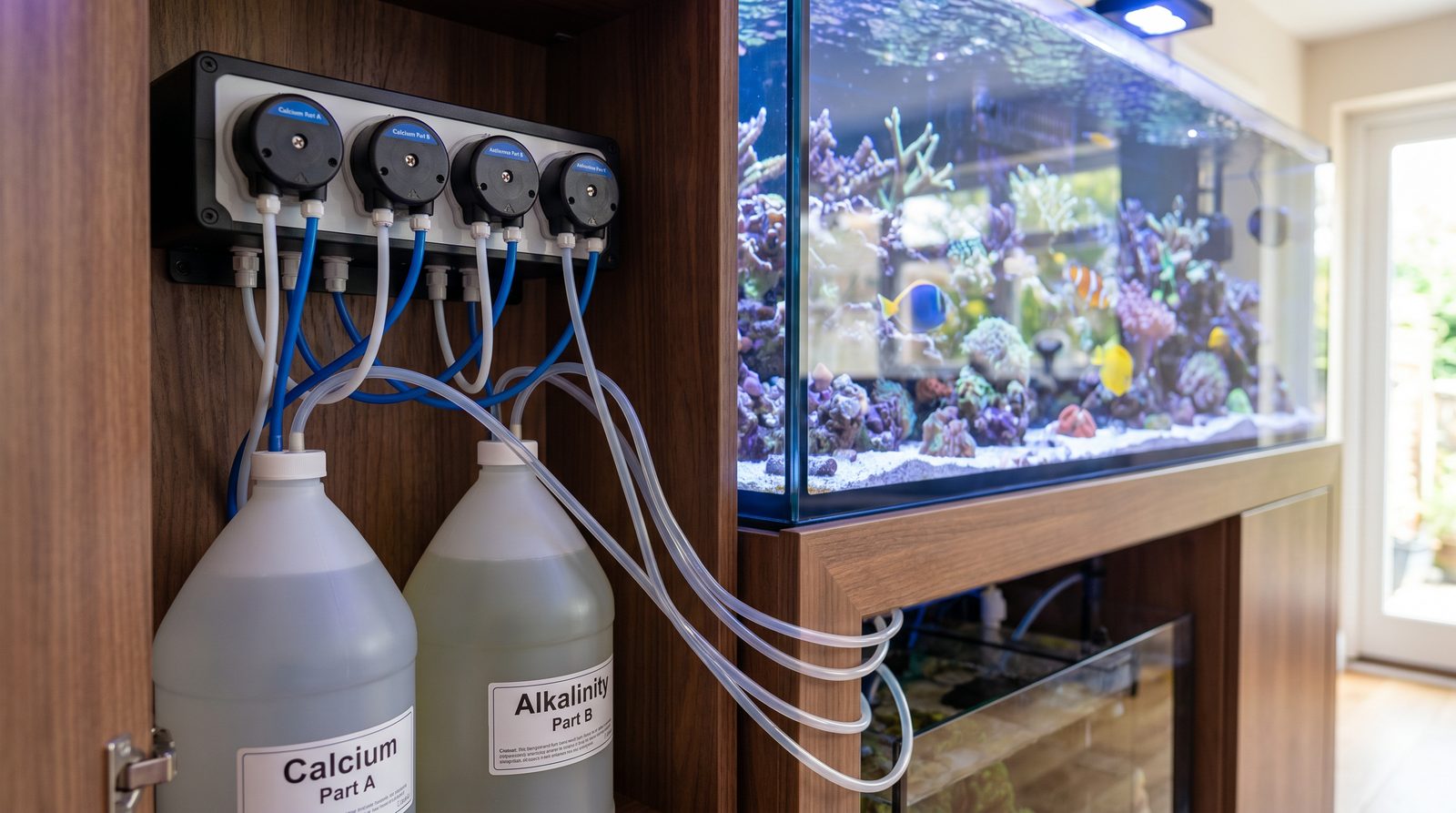
The right dose for your reef tank is the amount that replaces your corals' actual daily consumption — nothing more. To find it: stop dosing for 2–4 days, test alkalinity each morning at the same time, and calculate the average daily drop. That drop is your consumption figure. Set your dose to replace that amount. Recheck every few weeks as coral biomass grows, because consumption grows with it.
Most reef keepers start dosing the way they start most things in this hobby: by reading a label, following a forum recommendation, or copying what works in someone else's tank. For a while that approach often works. But as coral biomass increases, or as you switch from a softie-and-LPS system to a faster-growing SPS setup, the generic starting dose becomes the wrong dose — and the parameters start to drift. The solution is not to find a better recommendation to copy. It is to measure your own tank's consumption and dose to match it.
Why consumption is the only number that matters
Every reef tank has a unique daily alkalinity consumption. A bare tank with two small frags uses almost none. A mature tank packed with fast-growing Acropora colonies can consume 1.5 dKH or more per day. The volume of your tank, the size and species of your corals, how quickly they are growing, and even the season can all shift that number. No label, no online calculator, and no other reef keeper's experience can tell you your tank's figure — only a direct measurement can.
The same principle applies to calcium and magnesium, though they move more slowly. Alkalinity is the parameter to anchor your measurement on because it changes fastest and gives the clearest daily signal.
Step 1 — Measure your true daily consumption
- Stop dosing alkalinity additives for 2–4 days. If you are running a calcium reactor, either reduce the flow significantly or pause it. This is temporary and safe for that duration.
- Test at the same time each day — ideally each morning before the lights come on, when CO₂ has equilibrated overnight and the reading is most consistent. Record the exact value each time.
- Calculate the average daily drop. If you tested on day 0 (8.8 dKH), day 1 (8.3 dKH), day 2 (7.9 dKH) and day 3 (7.5 dKH), the drops are 0.5, 0.4 and 0.4 — an average of roughly 0.43 dKH per day. That is your consumption rate.
- Do not run the measurement below 7.5 dKH in a well-stocked tank. If you reach that level before four days are up, stop the measurement and resume dosing. You will still have enough data points to calculate a reasonable average.
Step 2 — Calculate your starting dose
Once you have your daily consumption figure, look at the dosing product you are using. Every alkalinity additive has a stated effect per unit volume — for example, a two-part solution might raise alkalinity by a certain number of dKH per millilitre per 100 litres of tank water. This information is on the label or the manufacturer's website.
The calculation is conceptually simple:
- Find the daily consumption in dKH (from your measurement above).
- Find the dose rate for your product: how many dKH does 1 ml raise in your tank volume?
- Divide consumption by dose rate to get the daily volume in ml.
- Split that total volume across several pump cycles per day — 4 to 6 cycles is better than one large bolus.
If you have switched products or are using a different brand than before, re-read the label — dose rates vary considerably between products and even between batches. Do not assume the same volume that worked with one product will work with another.
Step 3 — Ramp up safely if parameters need correcting
If your alkalinity has drifted during the measurement pause, or if it was already low before you started, bring it back up gradually. The widely accepted safe rate is no more than 1–1.5 dKH per day until you reach your target. Larger correction doses risk alkalinity shock in sensitive SPS corals — stalled polyps, tissue recession from the tips, and in severe cases rapid bleaching.
Once you reach your target value, switch to your calculated maintenance dose — the amount that replaces daily consumption without adding to it. Confirm the dose is working by testing every couple of days for the first two weeks. If the value is holding flat, your dose is correct.
| Phase | Goal | Safe daily change |
|---|---|---|
| Correction (value is low) | Bring alkalinity up to target | Maximum 1–1.5 dKH rise per day |
| Maintenance (value is at target) | Hold alkalinity steady | Flat — dose exactly equals consumption |
| Growth adjustment (value drifting down) | Increase dose to match higher consumption | Increase dose in small increments; retest in 3–5 days |
Step 4 — Recalculate as your tank grows
A dose that is perfect today will be insufficient in three months if your corals grow significantly. Most experienced reef keepers find they need to increase their dose every few months as biomass increases, and may also see a step-change after adding new frags or colonies. The signal is simple: alkalinity trending down despite a steady dose means consumption has outpaced dosing. Recheck your consumption rate and adjust the dose.
The reverse can also happen. If you lose a colony to a disease outbreak, or frag out a large portion of the tank, consumption drops and your previous dose may now be too high — pushing alkalinity slowly upward. Testing frequently is what catches both directions of drift.
Dosing calcium and magnesium by the same principle
The same measure-then-dose approach applies to calcium and magnesium, though the measurement periods are longer because these parameters move more slowly. For calcium, a useful measurement window is 5–7 days without dosing. For magnesium, a week to ten days. The calculation is identical: average daily drop → product dose rate → daily volume. If you are using a balanced two-part system, the calcium dose often works out close to the alkalinity dose by design. If one drifts significantly faster than the other, check for a water-change mismatch or a magnesium deficiency before increasing the dose unilaterally.
Using a logbook to close the feedback loop
Dosing is not a one-time calculation — it is an ongoing feedback loop between what you dose and what the tank shows you. The only way to close that loop reliably is to log every test with a date so the trend is visible. A parameter that is flat is a correctly dosed tank. A slow drift down is under-dosed. A slow drift up is over-dosed or a consumption drop. Each of those signals tells you exactly what to adjust, but only if you have enough data points to see the direction. Two or three tests a week logged consistently in ReefDeck will give you that picture within a fortnight of starting any new dose.
Log your tests, track your dose
ReefDeck records each alkalinity, calcium and magnesium test so you can calculate your consumption directly from your own data — and track whether a dose change is holding your parameters stable. Free, offline, no account required.
Open ReefDeck — it's free → Works on phone and desktop · installs as an app · exports to CSV anytimeFrequently asked questions
How do I calculate my reef tank's alkalinity consumption?
Stop dosing alkalinity for 2–4 days and test at the same time each morning. Record the value each day and calculate the average daily drop. That figure — typically expressed in dKH per day — is your tank's consumption rate, and your daily dose should replace exactly that amount.
How fast can I raise alkalinity if it is low?
The safe correction rate is no more than 1–1.5 dKH per day. Raising faster risks alkalinity shock in corals, which can cause polyp retraction, tissue recession and bleaching. Once you reach your target, switch to a maintenance dose that holds the value flat rather than continuing to add above the consumption rate.
Why is my alkalinity still dropping even though I am dosing?
The most common reason is that your corals have grown and their consumption now exceeds your dose. Repeat the consumption measurement, compare it to your current dose, and increase the dose to match. Other causes include a dosing pump running at the wrong rate, a water-change mismatch, or a precipitation event depleting both alkalinity and calcium simultaneously.
How often should I recalculate my dose?
Recalculate whenever you notice a persistent downward trend in alkalinity despite a stable dose, after a significant change in coral biomass (large additions or losses), and at least every three to four months as a routine check. Parameters that are trending flat confirm your current dose is correct; any drift in either direction is the signal to recheck.